Best Emergency Tree Service Response Tips

A tree can look stable right up until the moment it splits, lifts at the roots, or lands across a driveway. The best emergency tree service response tips start with one priority: protect people before you worry about the tree, the cleanup, or the cost. A fast, calm response can prevent an already stressful storm situation from becoming a serious injury or major property loss.
For homeowners and small commercial property owners, the right next step depends on where the tree is, what it has hit, and whether power lines are involved. Some damage can wait for a scheduled inspection. A hanging limb over your roof, a tree pressing against a building, or a trunk tangled in utility lines cannot.
Treat These Tree Problems as Emergencies
Not every fallen branch requires a middle-of-the-night call. A small limb in an open backyard can usually wait until daylight. But you should request emergency help right away when a tree or large limb has fallen on a home, garage, vehicle, fence, or occupied structure.
The same is true when a tree is leaning suddenly after wind or heavy rain, especially if you can see lifted soil or exposed roots on one side of the trunk. That can mean the root system is failing. Do not assume a leaning tree will settle back into place. Wind, saturated ground, and snow load can turn a lean into a fall with very little warning.
Call for urgent professional help if you see cracked major limbs hanging above a driveway, entrance, sidewalk, or play area. A broken limb may remain caught in the canopy for hours or days before it drops. These are often called hangers, and they are dangerous because the failure is unpredictable.
Utility involvement changes the situation immediately. If a tree, branch, or downed wire is near a power line, stay away and contact the utility provider or emergency services first. Treat every downed wire as energized, even if the power is out. Keep people, pets, ladders, tools, and vehicles clear of the area.
Your First 15 Minutes After Tree Damage
The safest response is usually the simplest one: create distance, limit access, and call the right people. Do not stand under damaged limbs to get a closer look. Do not climb onto a roof, pull on a branch, or try to cut wood that is bent, wedged, or under tension.
Start by moving everyone away from the hazard zone. If the tree has struck your home, leave the affected rooms. If there is structural damage, a gas smell, sparking, flooding, or a blocked exit, call 911. Use a safe alternate exit if one is available.
Then secure the area as much as you can without approaching the tree. Keep children, pets, tenants, customers, and neighbors out of the work zone. If the damaged tree blocks a driveway or entrance, use cones, caution tape, or visible markers from a safe distance. For a commercial property, restrict access promptly to reduce the chance of a visitor injury.
Take photos and short videos from a safe location. Capture the tree, the damage, the surrounding area, and any visible weather-related conditions. Documentation can help with an insurance claim and gives the tree service a clearer picture before they arrive. Do not delay an emergency call just to take perfect photos.
Best Emergency Tree Service Response Tips for Calling a Pro
When you call an emergency tree company, clear information helps the crew prepare the right equipment and respond safely. You do not need to diagnose the tree. Describe what you can see and where the immediate danger is.
Be ready to share whether the tree is on a house, vehicle, fence, road, driveway, or power line; whether anyone is trapped or injured; whether the tree is still moving or leaning; and whether there is safe access for a truck or crew. Mention locked gates, narrow driveways, parked vehicles, or low-hanging wires that could affect access.
Ask whether the company is licensed and insured, whether it handles emergency removal, and whether it has the equipment needed for your situation. A tree resting on a roof or tangled in other trees may require controlled cutting, rigging, or a crane. This is not the time to hire someone who plans to solve a high-risk job with a ladder and a chainsaw.
At AAA Tree Service NY, emergency crews focus first on making the site safe, then on removing the damaged tree or limbs in a controlled order. With more than 26 years of experience, the goal is not to sell work you do not need. It is to remove the immediate hazard and give you an honest assessment of what should happen next.
What You Should Never Do After a Storm
Storm cleanup often creates the urge to act quickly. That instinct is understandable, but some common actions make tree damage much worse.
- Do not cut a limb that is resting on a roof, fence, or another tree. It may be supporting weight or holding tension that can release without warning.
- Do not use a ladder near damaged branches. Wind, wet surfaces, and unstable wood create a high fall risk.
- Do not drive beneath hanging limbs or a leaning tree, even if you only need to move a vehicle.
- Do not touch, move, or cover a downed utility wire. Keep a wide distance and report it.
- Do not accept emergency work from an uninsured operator who cannot explain how the tree will be removed safely.
Even a branch that appears manageable can act differently once it is cut. Wood under pressure can spring, roll, twist, or snap back. Professional crews plan cuts around weight, tension, escape paths, nearby structures, and utility hazards.
Protect Your Insurance Claim Without Delaying Safety Work
After you have addressed immediate danger, contact your insurance company to report the loss. Keep photos, videos, invoices, written estimates, and notes about when the damage occurred. If possible, photograph the tree before major cleanup begins, but only from a safe distance.
Insurance coverage varies based on the cause of the damage, your policy, and what the tree struck. A healthy tree that falls during a severe storm may be handled differently than a tree that was clearly dead or neglected. Your insurer can explain your coverage, but the emergency tree crew can provide documentation of the observed damage and removal work.
Do not wait for an adjuster if the tree is actively threatening your home, blocking safe access, or creating a utility hazard. Preventing further damage comes first. In many cases, insurers expect you to take reasonable steps to protect the property after a loss.
Know What Happens During an Emergency Removal
A qualified crew should inspect the scene before cutting. They will look at the tree’s weight, break points, root stability, nearby buildings, utility lines, and the safest direction for lowering material. If conditions are too dangerous during high winds, lightning, or active utility hazards, they may secure the area and return when it is safe to proceed. That is caution, not delay.
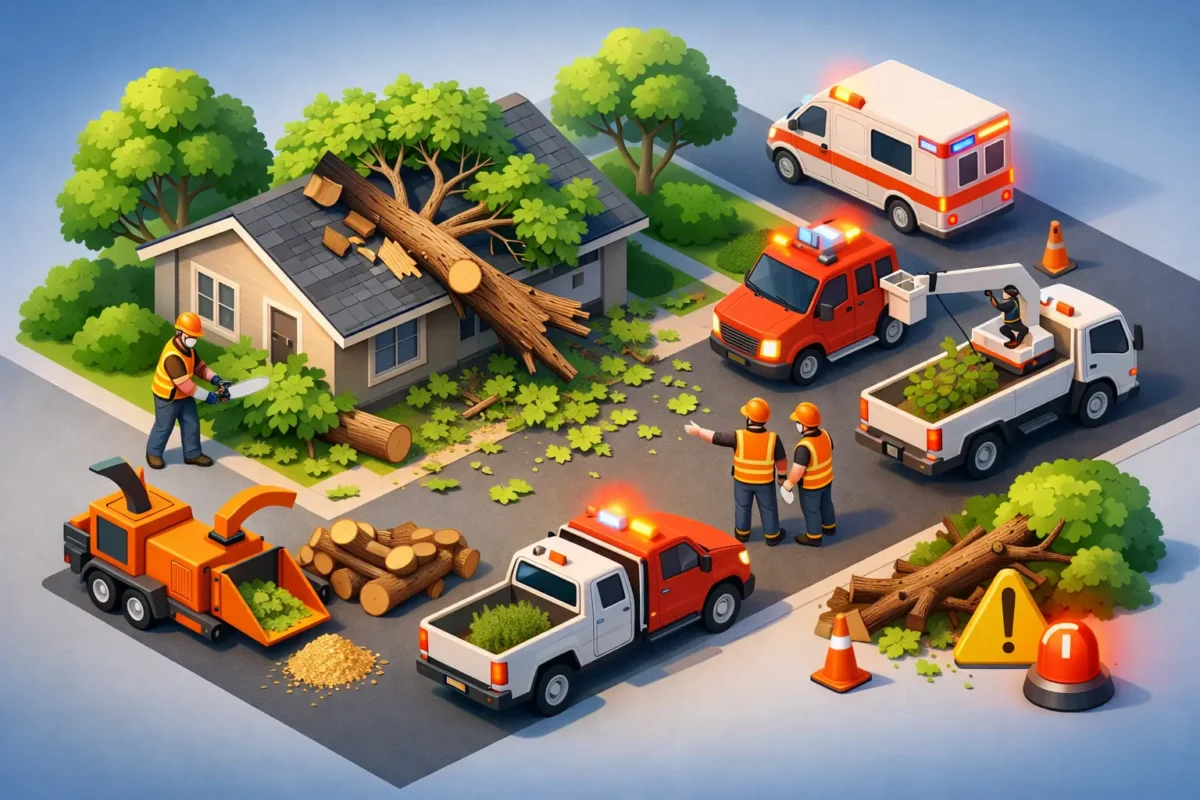
The work may begin with removing smaller branches to reduce weight and create access. Larger sections are then cut and lowered in a controlled way rather than dropped freely. If a tree is on a roof, the crew may need to remove it piece by piece to avoid causing more damage. Cleanup is usually part of the process, although stump grinding and full debris removal can depend on the scope of the emergency service you choose.
Be cautious about price promises made before anyone sees the site. Emergency work can cost more because of time, crew availability, specialized equipment, and the complexity of working near structures. A trustworthy company will explain what makes the job urgent, what work is necessary now, and what can wait.
Reduce the Chances of the Next Emergency
The best time to address a hazardous tree is before a storm makes it an emergency. Walk your property a few times each year, especially after heavy wind, ice, or prolonged rain. Look for dead limbs, cracks where large branches connect to the trunk, mushrooms near the base, hollow areas, peeling bark, and new leaning.
Pay close attention to trees near your roof, parking area, sidewalks, service lines, and neighbor boundaries. A tree does not have to fall completely to cause expensive damage. One dead limb over a parked car or entryway can be enough.
Routine pruning removes dead, weak, and overextended branches before they fail. It also helps a qualified tree professional spot decay, structural defects, and root problems that are easy to miss from the ground. Sometimes removal is the responsible recommendation. Other times, targeted pruning and monitoring are enough. It depends on the tree’s condition, location, and the risk it presents to people and property.
When a storm leaves you with a tree emergency, keep your distance, protect the area, and get experienced help. A safe response today can protect your home, your family, and the people who rely on your property tomorrow.