How to Identify Tree Decay Before It Becomes Dangerous

A tree can look green, full, and healthy from the street while its core is breaking down underneath. That is what makes decay so dangerous around a home, driveway, parking area, or power line. Knowing how to identify tree decay helps you act before a heavy branch falls or an entire weakened tree fails during the next storm.
Decay does not automatically mean a tree must come down. Some trees can live for years with a small, contained decayed area. The concern is where the decay is located, how much sound wood remains, and what the tree could hit if it breaks. If you see signs of serious decay near a target such as your roof, vehicles, play area, or building entrance, do not wait for high winds to test it.
How to Identify Tree Decay From the Ground
You do not need to climb a tree or cut into it to spot many warning signs. In fact, climbing or probing a questionable tree can put you in harm’s way. Start by walking around the tree from a safe distance and look at the trunk, root flare, major limbs, and ground below.
Look for mushrooms and fungal growth
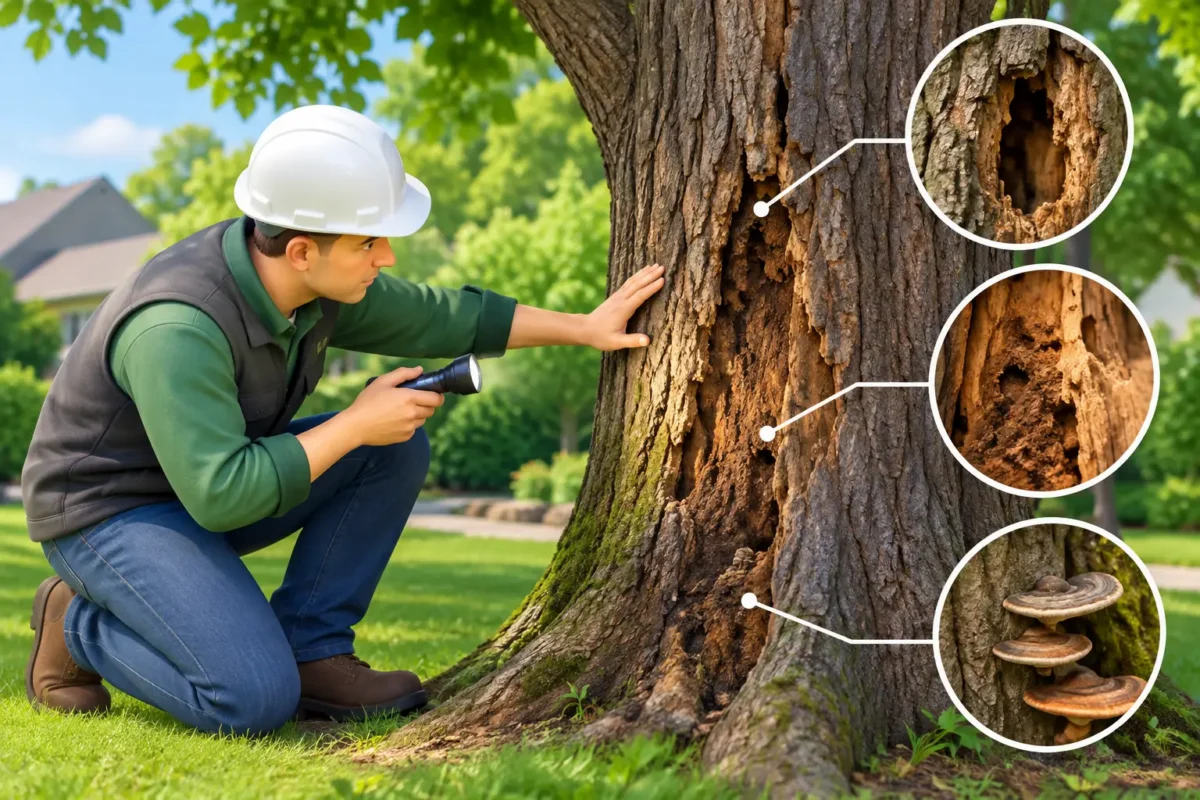
Mushrooms growing from the trunk, major roots, or at the base of a tree are one of the clearest signs that decay may be present. Fungi feed on wood, so fruiting bodies often mean there is decaying tissue inside or below the visible surface.
Not every mushroom nearby is a reason for alarm. Mushrooms growing in mulch or old buried wood may have nothing to do with the standing tree. What matters is fungal growth attached directly to the trunk or emerging from the root area. Shelf-like fungi, large clustered mushrooms, or recurring growth in the same place deserve a professional inspection.
Check for cavities, holes, and missing bark
An open hollow, a deep crack, or an area where bark has fallen away can expose wood to moisture and organisms that cause decay. Sometimes the tree has grown thick rolled edges around an old wound. That response can be a positive sign, but it does not prove the wood behind it is solid.
Pay close attention to cavities on the lower trunk and at the point where large limbs join the tree. Decay in these structural areas can reduce the tree’s ability to support its own weight. A dark opening may look small from outside while the hollow area inside is much larger.
Watch for soft, crumbly, or discolored wood
Healthy wood is firm. Decayed wood may look darker than the surrounding trunk, feel spongy, or break apart in small, dry pieces. You may also notice white, stringy material or a reddish-brown cubical pattern in exposed wood. These are signs of different types of wood rot.
Do not jam a screwdriver, axe, or other tool into the trunk to test it. Creating a new wound can worsen the problem, and you cannot reliably judge the extent of internal decay that way. A trained tree professional can assess the tree without causing additional damage.
Notice dead branches high in the canopy
Dead limbs do not always mean the trunk is decayed. Branches can die from shade, drought, insect pressure, or storm damage. But widespread deadwood, bare sections in the upper canopy, or large branches dying back from their tips can point to a larger health or structural issue.
Look up after a storm, but keep your distance. Hanging limbs can drop without warning, especially when they are wet, snow-covered, or caught in another branch. If a dead limb is over your home, driveway, sidewalk, or commercial entrance, have it removed promptly.
The Base of the Tree Often Tells the Real Story
Many of the most serious tree failures begin below ground. Root decay can leave a tree standing upright until saturated soil and wind expose the weakness all at once.
A healthy tree usually widens at the base where the trunk meets the roots. Look for a visible root flare rather than a trunk that disappears straight into piled soil, mulch, or landscaping stone. Soil built too high against the trunk holds moisture against the bark and can contribute to decay over time.
Warning signs around the base include new cracks in the soil, raised or heaving roots, a fresh lean, or a gap opening between the roots and surrounding ground. These symptoms are especially urgent after heavy rain or wind. A tree that suddenly leans toward your house, parking lot, or utility line needs immediate attention.
Root decay can also show up as thinning leaves, smaller leaves than normal, or dieback in the crown. Still, leaf problems alone are not enough to diagnose decay. Weather stress and pests can create similar symptoms. The combination of canopy decline, fungi, and root-area changes is more concerning than any one sign by itself.
Cracks and Weak Branch Unions Need Fast Attention
Not all cracks are decay, but decay can make cracks much more likely to spread. Check the trunk and main limbs for long vertical splits, deep seams, or bark that appears pinched between two stems.
A narrow, V-shaped branch union is weaker than a broad, U-shaped union, particularly if bark is trapped inside the connection. This is called included bark. It prevents the two stems from forming a strong attachment and can split apart under snow, ice, or wind.
If you can see a crack in a main trunk or a large limb over a high-use area, treat it as a safety issue. Do not park beneath it, place a ladder against the tree, or try to remove the limb yourself. The wood may be holding under tension, and cutting it incorrectly can cause sudden movement.
Know the Difference Between a Manageable Problem and an Emergency
Tree decay is not an automatic removal sentence. A decayed limb may be safely pruned, and a cavity in a tree far from people and structures may simply need monitoring. The right recommendation depends on the species, size, overall health, decay location, and the potential target below it.
You should schedule an inspection soon if you notice mushrooms on the trunk, a new cavity, several dead limbs, exposed rotten wood, or a tree that is declining near your property. Routine pruning or selective removal may reduce the risk before it becomes urgent.
Call for emergency help if the tree has suddenly leaned, roots are lifting, a major limb is cracked or hanging, or the trunk has split. Keep people, pets, and vehicles away from the area. If branches are touching power lines, stay clear and contact the utility company or emergency services as appropriate. Never attempt to move energized limbs yourself.
In Albany County and across areas that see heavy snow, freezing rain, and strong seasonal winds, small structural defects can become major failures quickly. A tree that seems stable on a calm afternoon may not stay that way during a nor’easter or wet spring storm.
What a Professional Tree Inspection Can Confirm
A qualified, insured tree service can inspect the areas you can see and assess risks that are harder to judge from the ground. They will look at trunk condition, root stability, limb attachments, canopy balance, prior pruning wounds, and nearby targets. If the tree can be retained safely, honest recommendations may include deadwood removal, weight reduction pruning, or periodic monitoring.
Sometimes removal is the safer and more affordable choice, particularly when extensive decay affects the lower trunk or root system. Waiting can turn a planned job into storm damage cleanup, roof repairs, blocked access, or an insurance claim. The goal is not to remove every imperfect tree. It is to make a clear decision based on real risk.
AAA Tree Service NY provides safety-focused tree assessments, pruning, removal, and 24/7 emergency response for property owners who need fast help. A free estimate gives you a practical next step without guessing at what is happening inside the tree.
If you have spotted decay, mark off the area below the tree and arrange an inspection before the next stretch of severe weather. Acting early gives you more options and helps protect the people and property that matter most.