Tree Pruning vs Tree Removal: Which Do You Need?

A branch hanging over your roof may need a careful trim. A tree with a cracked trunk, lifting roots, or a sudden lean may need to come down. Tree pruning vs tree removal is not just a question of appearance. It is a decision about protecting your home, family, vehicles, and the people who use your property.
The right answer depends on the tree’s health, location, structure, and risk level. Pruning can extend the life of a healthy tree and reduce storm damage. Removal is sometimes the safest choice when a tree cannot be repaired or is too likely to fail. A professional inspection gives you an honest recommendation before a small concern turns into an emergency call.
Tree Pruning vs Tree Removal: The Main Difference
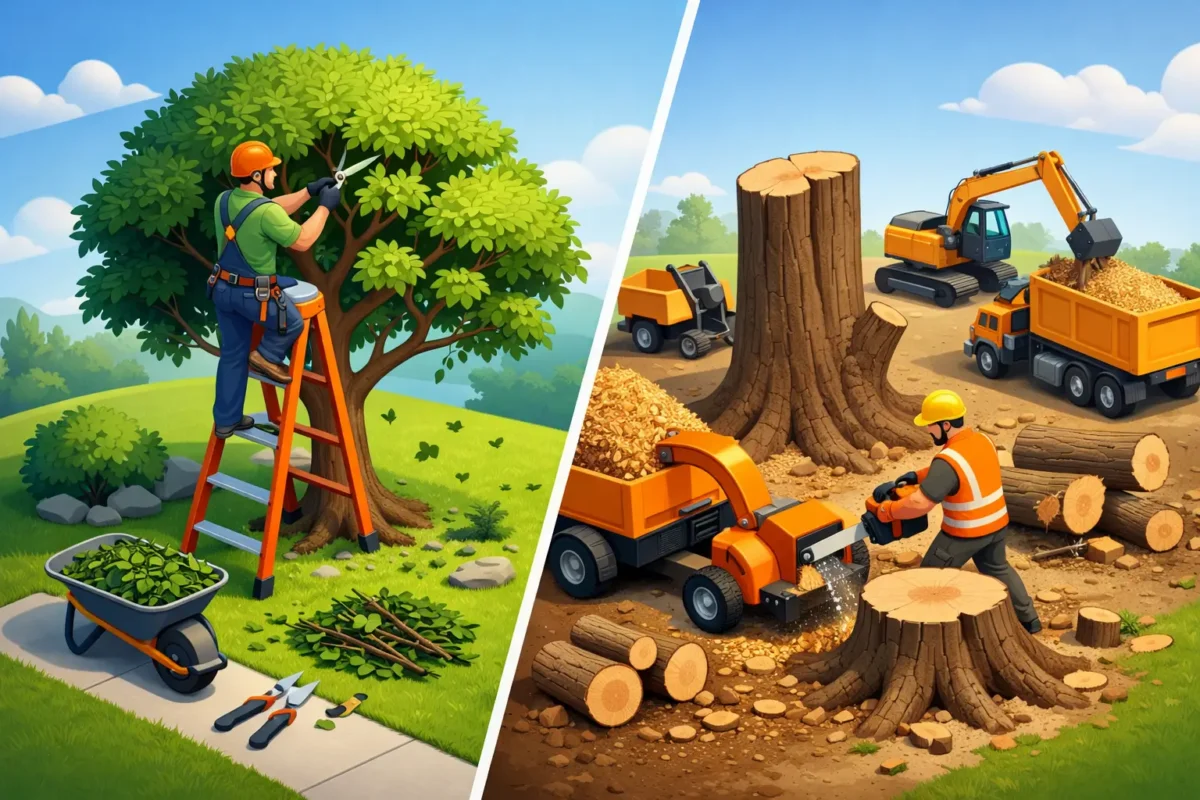
Tree pruning means selectively cutting branches to improve a tree’s health, shape, clearance, or safety. The tree remains in place. A proper pruning job removes dead, weak, crossing, diseased, or poorly placed limbs without stripping the tree of the foliage it needs to grow.
Tree removal means taking down the entire tree, usually in controlled sections when it is near a house, power lines, fences, or other structures. It may be followed by stump grinding if you want the remaining stump removed from the yard.
Neither service is automatically better. Removing a healthy tree simply because it drops leaves is often unnecessary. On the other hand, repeatedly cutting back a tree with a decaying trunk or major root damage does not make it safe. The goal is to keep healthy trees where they belong and remove hazards before they cause damage.
When Pruning Is the Right Choice
Pruning is usually the best option when the tree is structurally sound and the problem is limited to certain branches. Many mature trees benefit from routine maintenance every few years, especially trees close to roofs, driveways, sidewalks, and parking areas.
You may need pruning when dead limbs are visible in the canopy, low branches block a walkway or driveway, or limbs are rubbing against your roof or siding. It is also useful when branches are growing into each other, hanging over a pool, blocking security lighting, or crowding a neighboring tree.
A good pruning plan can reduce wind resistance without leaving the tree bare. That matters in New York, where heavy snow, ice, high winds, and saturated ground can turn an overlooked limb into a major problem. Thinning selected branches allows wind to move through the canopy more easily. Removing deadwood also prevents brittle branches from dropping without warning.
Pruning can help a tree look better, but safety should lead the decision. Avoid asking for severe topping, where large sections of the upper canopy are cut off. Topping often creates weak regrowth, exposes the tree to decay, and can make future failures more likely. If a tree needs drastic cutting every year just to stay away from your house, removal may be the more practical long-term answer.
Pruning does not fix every problem
Branch trimming cannot correct a trunk that is hollowed by decay, roots that are heaving out of the soil, or a tree that is leaning toward a building after a storm. It also cannot restore strength to a split main stem. In these cases, removing a few limbs may reduce some weight, but it does not eliminate the underlying risk.
That is why a tree should be evaluated as a whole. The canopy gets attention because it is easy to see, but the trunk flare, root zone, soil condition, and attachment points matter just as much.
Signs Your Tree May Need Removal
A tree does not have to be completely dead to require removal. Some dangerous trees still have green leaves and appear healthy from a distance. Internal decay, root failure, and structural defects can be hidden until a storm exposes them.
Removal should be considered when you see several warning signs, especially if the tree is within striking distance of your house, garage, power lines, road, or a frequently used part of the yard.
- The tree has developed a new or worsening lean, particularly after wind, rain, or snow.
- Large cracks run through the trunk, or a major limb has split away from the main stem.
- Mushrooms, soft wood, deep cavities, or peeling bark suggest extensive decay near the base.
- Roots are broken, lifting from the ground, cut by construction, or pushing up surrounding soil.
- More than half of the canopy is dead, or the tree is declining year after year despite normal care.
- A tree has been hit by lightning, severely damaged in a storm, or has lost a major supporting limb.
One symptom does not always mean immediate removal. For example, a small cavity may be manageable if the tree is otherwise healthy and far from targets. But a cavity combined with a heavy lean over your roof is a different situation. Risk increases when a defect is severe, the tree is close to people or property, and failure is likely during the next storm.
Location Changes the Decision
The same tree can be a minor concern in one location and an urgent hazard in another. A damaged maple at the far edge of a large lot may be monitored or pruned. That same maple leaning over a child’s play area, commercial parking lot, or busy sidewalk needs quick attention.
For homeowners, consider what the tree could hit if it falls or drops a limb. Look beyond the roof. Fences, sheds, decks, vehicles, pools, septic areas, and neighboring property all matter. For building owners, trees over entrances, walkways, loading areas, and customer parking can create injury and liability concerns as well as property damage.
Power lines require special caution. Never attempt to cut branches that are touching, arcing near, or tangled in electrical lines. Keep people away from the area and contact the utility company or a qualified tree service. A tree crew can assess the tree, but utility-related work must be handled with the right coordination and clearance procedures.
When to Act After a Storm
Storm damage often makes the decision clearer. A broken branch resting in another branch may look stable, but it can fall later as wood dries, wind shifts, or ice melts. A partially uprooted tree can fail without much warning, particularly after the soil has been soaked by days of rain.
Call for emergency tree help right away if a tree or large limb is on your home, blocking access, resting on a vehicle, or threatening to fall onto a structure. Do not stand beneath a hanging limb, climb a damaged tree, or use a ladder and chainsaw to handle high branches. Those situations are dangerous even for experienced people without the right equipment and crew support.
If the tree is damaged but not an immediate threat, keep people and pets away from the drop zone and schedule an inspection promptly. Taking clear photos from a safe distance can help document the issue for insurance purposes, but your safety comes first.
Cost, Value, and the Honest Answer
Pruning is often less expensive than removal because it involves less labor, equipment, hauling, and site work. It can also preserve shade, privacy, curb appeal, and the value a healthy mature tree brings to your property.
Removal costs more when a tree is large, close to structures, difficult to access, or requires specialized rigging. Stump grinding is generally a separate consideration. Still, delaying a necessary removal to save money can lead to far greater costs if the tree damages a roof, vehicle, fence, or neighboring property.
The best value is not always the lowest quote or the biggest job. It is the service that addresses the real risk. A trustworthy tree professional should explain why pruning is enough, why removal is recommended, and what can reasonably wait. You should not feel pressured to remove every mature tree on your property.
Choose a Safe, Professional Assessment
Tree work is one of the most hazardous jobs around a home or commercial site. A falling limb can swing unpredictably, and a tree can shift as cuts are made. Make sure the company you hire is licensed and insured, uses appropriate safety practices, and has experience working around homes, tight yards, and storm-damaged trees.
Ask what work is being recommended and why. If removal is suggested, ask whether the tree has a structural defect, disease, root issue, or a location-based hazard. If pruning is recommended, ask what branches will be removed and whether the work will preserve the tree’s health. Clear answers are a good sign that the recommendation is based on your property, not a one-size-fits-all sales pitch.
If you are unsure whether a limb needs trimming or a tree needs to come down, do not wait for the next high-wind warning to decide. A free on-site estimate from an experienced, insured tree service can give you a clear plan and the peace of mind to act before the risk gets worse.