Backyard Tree Hazard Assessment Example

A tree can look fine from the patio and still be one hard rain away from dropping a limb over your fence, roof, or driveway. That is why a backyard tree hazard assessment example helps. It gives you a practical way to look at what is happening in your yard before the next storm turns a manageable problem into an emergency.
If you are a homeowner, the goal is not to diagnose every tree issue like an arborist. The goal is simpler. You want to spot obvious risk, understand what can wait, and know when to call for professional help right away.
What a backyard tree hazard assessment example should show
A useful assessment is not just a list of defects. It connects three things: the condition of the tree, what the tree could hit if it fails, and how likely failure is in the near term. A dead tree in the back corner of a large lot is not the same risk as a cracked maple hanging over your child’s play area.
That is where many property owners get tripped up. They focus only on whether a tree looks unhealthy. Health matters, but hazard is about target and timing too. A tree can be in decline for years without posing an immediate threat. Another tree can look mostly alive and still have a split trunk that makes it dangerous now.
Backyard tree hazard assessment example
Here is a plain-language example of how you might assess one tree in a residential yard.
Example property situation
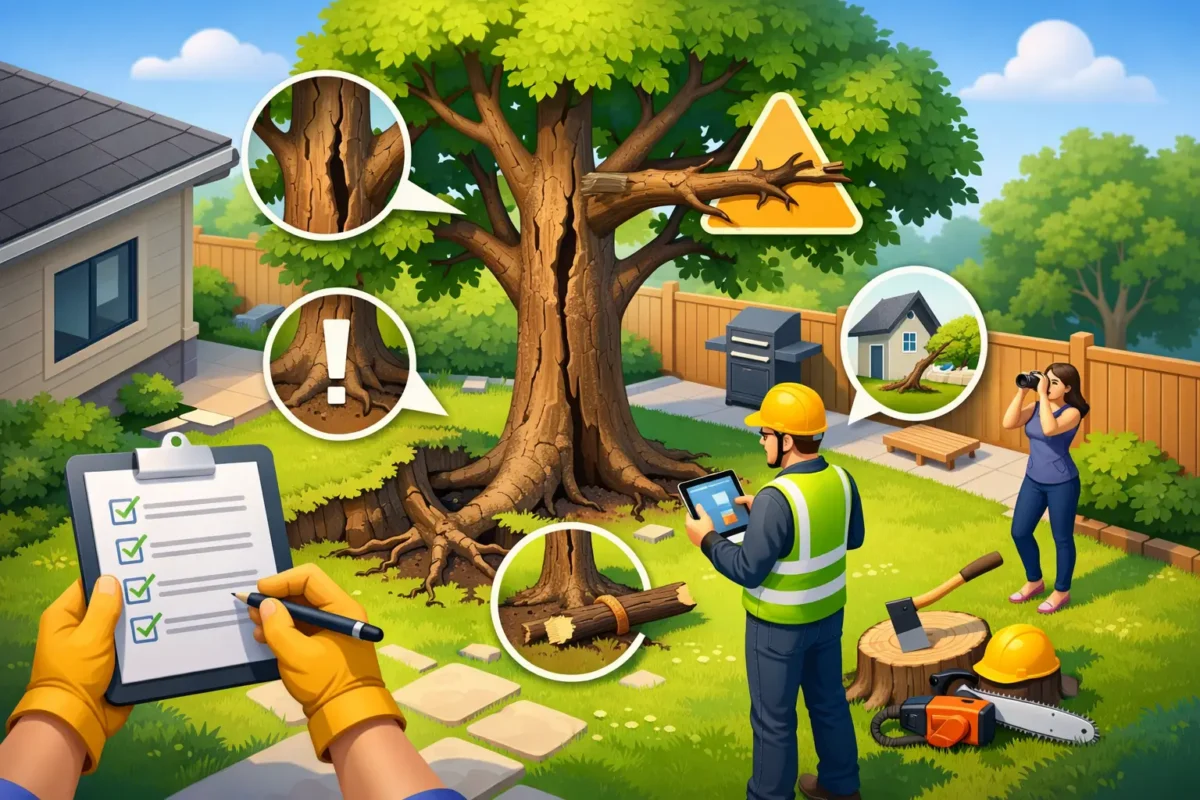
You have a mature red maple about 45 feet tall in the backyard. It is roughly 18 feet from the house and extends over part of the roof. A section of the canopy also reaches over a wooden fence and a spot where your family parks a car. The tree looked full last summer, but after a recent windstorm you noticed one side thinning out. You also saw a long vertical crack where two major stems join.
The ground around the base stays wet after heavy rain. There is visible fungus near the root flare, and one large limb has dead branches with no leaves. The tree leans slightly toward the house, though you are not sure whether that lean is new.
Sample hazard assessment
Tree species and size: Mature red maple, approximately 45 feet tall, multi-stem structure.
Targets: House roof, fence, parked vehicle, backyard activity area.
Visible defects: Included bark at stem union, vertical crack between co-dominant stems, deadwood in upper canopy, fungal growth near base, wet soil around roots, moderate lean toward structure.
Likelihood of failure: Moderate to high. The crack at the union is the biggest concern because stem failures can happen suddenly, especially during wind or saturated soil conditions. Root stress may also be a factor because persistent wet soil can weaken anchoring.
Likelihood of impact: High. If either main stem or a large scaffold limb fails, it is likely to strike the roof, fence, or vehicle area.
Consequences: Significant property damage is possible. There is also a personal safety risk if the yard is in use during failure.
Recommended action: Prompt professional inspection. Pruning deadwood alone is probably not enough if the stem union is compromised. Depending on the extent of the crack and root condition, the tree may need cabling, heavy reduction, or removal. If the crack appears to widen, the tree shifts after rain, or more canopy dieback develops, treat it as urgent.
That is the basic logic behind a good assessment. You are not trying to write a scientific report. You are trying to answer a practical question: Is this tree safe enough to monitor, or risky enough to act on now?
How to assess a backyard tree hazard without guessing
Start from the ground and work upward. Look at the base first because root and trunk problems often matter more than a few dead twigs in the canopy. Soil heaving, exposed roots, cavities, mushrooms at the base, and fresh cracking in the trunk deserve attention. If the ground is lifting on one side or the tree suddenly started leaning, do not wait for a calmer weekend to deal with it.
Then check the trunk and major unions. A common backyard problem is a tree with two main stems growing tightly together. From a distance it can look strong. Up close, you may see included bark, which means bark is trapped between stems instead of solid wood joining them. That weak connection can split under storm load.
After that, study the canopy. Dead branches, hanging limbs, sparse leaf-out on one side, and branches rubbing against each other are all worth noting. Deadwood by itself does not always mean the whole tree is failing, but large dead limbs over a roof or walkway still create a serious hazard.
Finally, think about what sits under the tree. A declining tree over open woods is one thing. The same tree over your home, garage, driveway, or a neighbor’s fence is another. Risk goes up when there is something valuable, occupied, or hard to move beneath it.
Warning signs that move a tree from watch list to urgent problem
Some issues can be monitored for a season. Others should push you to get help quickly. A fresh crack in the trunk or where a large limb joins the tree is one of the biggest red flags. So is a tree that suddenly leans more than before, especially after storms or soaking rain.
Large dead limbs over living space also need prompt attention. The same goes for root damage after excavation, repeated branch drop in calm weather, or a hollow trunk with visible decay near the base. If you can see movement in the root plate, hear cracking, or notice the soil lifting, keep people away from the area and call for emergency service.
In New York, storm patterns matter. Heavy wind, wet snow, and saturated ground can expose weak trees fast. A tree that made it through past seasons can still fail this year if decay has advanced or roots have been stressed.
What homeowners often get wrong
One common mistake is assuming green leaves mean a safe tree. A tree can leaf out and still have major structural defects. Another is focusing only on the lean. Some trees naturally lean and remain stable for years, while a straight tree with hidden decay can be more dangerous.
Homeowners also tend to underestimate limb weight. A large branch does not have to come from the whole tree to cause expensive damage. One failed limb can crush a shed, tear gutters off a house, or injure someone below.
The other mistake is waiting too long because the tree is close to a property line, landscaping, or a favorite shade area. That hesitation is understandable. But delay usually makes the job more complicated and more expensive, especially after a storm when access is harder and demand is high.
When a professional tree inspection makes sense
A homeowner can do a basic visual check, but there is a limit to what you should judge from the ground. If the tree is tall, close to a structure, split, decayed, storm-damaged, or dropping limbs, it is time for a professional assessment. The same is true if you are managing a small commercial property and liability is a concern.
An honest tree service should tell you when a tree can be pruned and monitored instead of removed. Not every problem calls for full removal. Sometimes selective pruning, weight reduction, cabling, or clearing deadwood is enough to lower risk. Other times, removal is the safer and more cost-effective call because the defect is in the trunk or root system where pruning will not solve the real issue.
That is why experience matters. A safety-first crew will look at the whole picture, not just sell the biggest job. Companies like AAA Tree Service NY often handle both routine hazard reduction and emergency storm response, which gives homeowners a more practical read on what is truly urgent.
A simple standard for your own yard
If you want a quick rule, use this one: a tree becomes a priority when it has a visible defect, a realistic chance of failure, and something important underneath it. Take away any one of those factors and the urgency may drop. Put all three together and you should act sooner rather than later.
You do not need to panic over every imperfect tree in your yard. Trees are living structures, and many flaws can be managed. But if you see cracking, decay, dead limbs, root problems, or a sudden lean near your home, trust what you are seeing and get it checked before weather makes the decision for you.
The best time to deal with a hazardous backyard tree is when you still have options, not when it is already on the roof.