Tree Inspection After Windstorm Damage

The storm has passed, but that does not mean the danger is over. A proper tree inspection after windstorm damage can reveal cracked limbs, split trunks, root failure, and hanging branches that are easy to miss from the ground. If a tree is close to your home, driveway, sidewalk, or power lines, waiting too long can turn storm damage into a much bigger and more expensive problem.
In New York, windstorms often leave behind more than obvious fallen branches. A tree may still be standing and look mostly fine, while the root plate has started to lift or a major limb has split and is only being held by bark. That is why the first inspection matters. You are not just checking for cleanup. You are checking for risk.
Why tree inspection after windstorm damage matters
A damaged tree does not always fail right away. Sometimes it comes down in the next round of wind, after heavy rain softens the soil, or when snow loads settle on already weakened limbs. What looks stable in the morning can become an emergency by night.
For homeowners, the concern is obvious – roof damage, crushed vehicles, blocked driveways, and danger to your family. For small commercial property owners, the stakes also include liability. A broken limb over a parking area or entrance is not something to put off until next week if the tree is already compromised.
The goal of an inspection is simple. You want to know what needs immediate action, what can wait for scheduled work, and what is safe to monitor. Honest advice matters here. Not every storm-touched tree needs removal, but some do, and guessing is not a safe plan.
What to do before you inspect storm-damaged trees
Start with distance. Do not walk under hanging limbs, do not touch branches tangled in utility lines, and do not try to move large broken sections on your own. If you see a tree leaning onto a structure or wires, treat it as an emergency.
A visual check from a safe area is the right first step. Use daylight if possible. Look from several angles and pay attention to what changed after the storm. A tree that leaned slightly for years is different from one that shifted overnight.
If the ground is saturated, be extra careful. Wet soil can make root failure worse, especially around large mature trees. In parts of Albany County, Nassau County, Suffolk County, and other storm-prone service areas, wind and rain together often cause damage below grade that homeowners do not notice until the tree starts to move.
How to spot the most serious warning signs
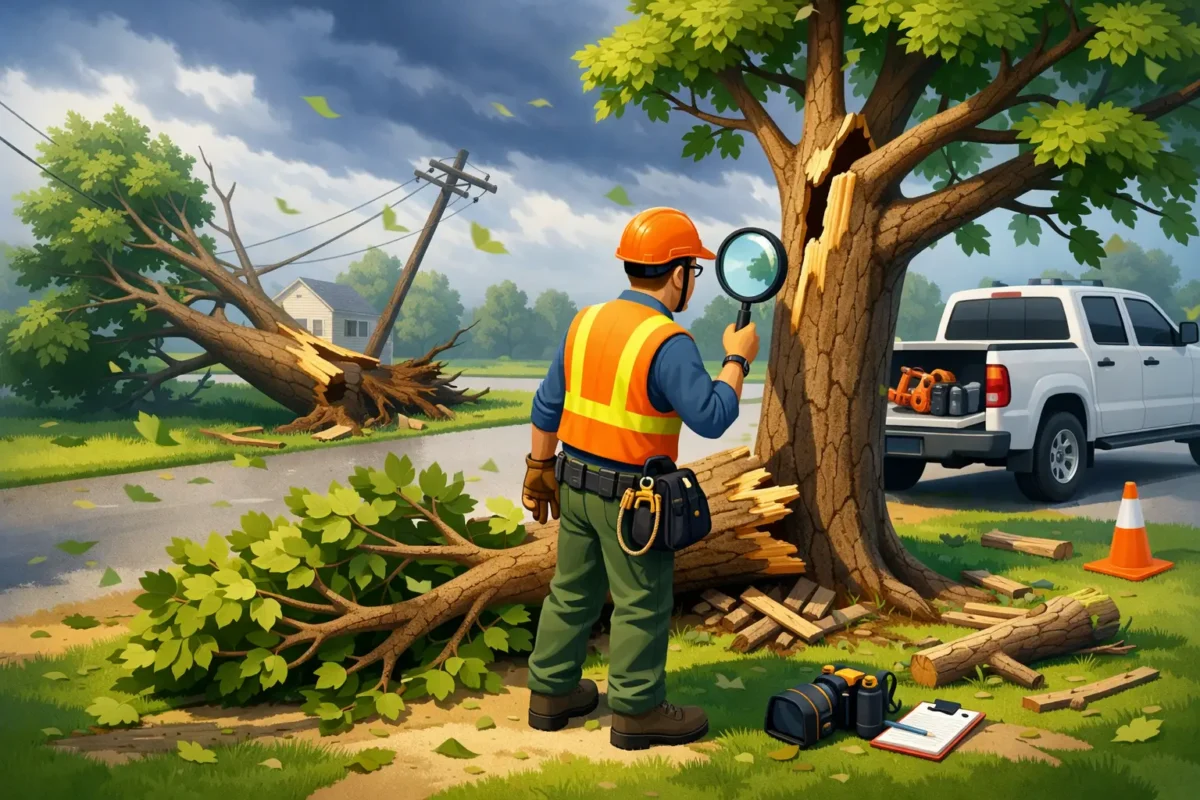
Some damage is clearly urgent. Other signs are subtle but still serious. During a tree inspection after windstorm conditions, look for fresh cracks in the trunk, major limbs split at the attachment point, branches hanging in the canopy, and exposed roots or heaving soil at the base.
A sudden lean is one of the biggest red flags, especially if the tree now points toward a house, garage, fence, or roadway. Leaning does not always mean immediate failure, but a new lean after high wind should never be ignored.
Watch for bark peeled away from the trunk, long vertical splits, and cavities that opened wider during the storm. These signs can mean the structure of the tree was already weak and the wind pushed it closer to failure.
Broken tops and torn limbs are also a problem even when the tree is still upright. A large branch partially attached overhead can fall without warning. Homeowners often focus on what landed in the yard and miss what is still stuck in the canopy.
Start at the root zone, not just the branches
Most people look up first. That makes sense, but the base of the tree tells you a lot. Check for cracked soil, lifted roots, and a mound of earth pushed up on one side. Those are common signs the root system shifted.
If mulch or grass near the trunk looks newly disturbed, or if the tree seems to be pulling out of the ground, stop there and call for professional help. Root damage changes everything. A tree can keep standing for a short time and still be unsafe.
Large trees near patios, driveways, retaining walls, and foundations deserve extra attention because restricted rooting areas can make them less stable after a storm. The tree may have survived for years, then one major wind event exposes the weak point.
Then check the trunk and main scaffold limbs
After the root area, inspect the trunk from bottom to top as best you can from the ground. You are looking for splits, twisting, fresh wounds, and any area where wood fibers appear pulled apart. If the trunk has a deep crack, the tree may not be safe to keep.
Next, look at the main limbs. Strong branch unions usually hold better in storms. Weak attachments, especially those with bark trapped between stems, are more likely to split. If one side of the canopy is suddenly sparse or uneven, a major limb may have broken and hung up in the crown.
This is not a climbing job for a homeowner. Storm-damaged trees are unpredictable. A limb can shift when touched, and internal cracking is not always visible.
What damage can wait, and what cannot
Not every broken branch means emergency removal. Small limb loss in an otherwise healthy tree may only require cleanup and pruning. Cosmetic damage, minor twig drop, and a few scattered branches in the yard are common after wind and usually not urgent.
What cannot wait is a tree on a structure, a tree on or near power lines, a split trunk, a hanging limb over a walkway or driveway, or visible root failure. Those situations call for immediate service because the risk to people and property is already high.
There is also a middle category. A tree may be damaged but not at the point of collapse. In those cases, timely pruning, cabling in limited situations, or removal of specific compromised limbs may solve the problem. This is where experience matters. The right recommendation should fit the actual condition of the tree, not a one-size-fits-all sales pitch.
Why hidden damage is so easy to miss
Storm damage is not always dramatic. Internal cracks, stress fractures at branch unions, and root injury under wet soil can stay out of sight until the next weather event. That is why a tree that “made it through” one storm is not automatically safe.
This is especially true for older trees, trees with previous pruning wounds, and species that tend to split under heavy wind or ice load. If your property has mature shade trees close to the house, it is smart to get them checked after a major storm even when the yard looks mostly clean.
A professional inspection can also help you avoid unnecessary work. Sometimes a tree looks rough but is structurally sound with corrective pruning. Other times a tree still has leaves and appears stable, yet the trunk or root system is badly compromised. Looks alone are not enough.
When to call for professional help right away
Call immediately if a tree is touching your home, blocking access, leaning over occupied areas, or threatening power lines. The same goes for any tree with a split trunk, uprooting, or heavy hanging branches. These are not wait-and-see situations.
If you are unsure, treat uncertainty itself as a reason to get help. A fast inspection is much cheaper than roof repairs, vehicle damage, or an injury claim. For homeowners and small commercial properties, quick action is usually the safest and most affordable choice.
AAA Tree Service NY handles emergency storm response with a safety-first approach, and that matters after wind damage. You want a licensed and insured crew that can tell you clearly what needs immediate work, what can be scheduled, and what does not need to be touched.
How to reduce the next storm risk
After the urgent problems are handled, the next step is prevention. Trees with dead limbs, overextended branches, dense canopies, or existing structural weakness are more likely to fail when the next windstorm hits. Pruning at the right time can reduce weight, improve balance, and remove weak growth before it breaks.
That does not mean every tree should be thinned aggressively. Over-pruning can create new problems, including stress and poor branch structure. Good storm prep is selective. It focuses on deadwood, hazardous limbs, clearance from structures, and overall stability.
If you have trees close to your home, parking area, fence line, or business entrance, routine inspections are a smart part of property maintenance. They help you act before damage becomes an emergency, not after.
The safest time to deal with a storm-damaged tree is before the next storm tests it again. If something on your property does not look right, trust that instinct and get it checked while the weather is calm.