Can a Leaning Tree Be Saved?

A tree that suddenly starts leaning after a storm gets your attention fast, and for good reason. If you’re asking can a leaning tree be saved, the answer depends on one thing above all else – why it is leaning. Some trees can recover with the right support and pruning. Others are no longer stable and need to be removed before they hit your home, driveway, fence, or power lines.
The biggest mistake homeowners make is assuming every leaning tree is an emergency, or worse, assuming none of them are. A slight lean that has developed naturally over years is very different from a tree that shifted overnight after heavy rain or high wind. Knowing the difference can protect your property and help you avoid paying for work you do not need.
Can a leaning tree be saved, or is it too late?
A leaning tree can sometimes be saved if the root system is still mostly intact, the trunk is not split, and the lean is caught early. Younger, smaller trees have the best chance. They are lighter, more flexible, and more likely to respond to staking or corrective pruning.
A mature tree is a different story. If a large tree has started leaning suddenly, especially after a storm, that often points to root failure or soil movement. At that point, the question is less about saving the tree and more about whether it is still safe to leave standing. A large unstable tree near a house or parking area is not something to watch and wait on.
The timing matters too. If the tree has been leaning for years and still shows healthy growth, full leaves, and no cracking at the base, it may simply have adapted to its position. Trees do not always grow perfectly straight. But a new lean, exposed roots, lifted soil, or a trunk that appears to be pulling out of the ground should be treated as a warning sign.
What causes a tree to start leaning?
Leaning is usually a symptom, not the real problem. Wind, saturated soil, root damage, decay, and poor structure can all be behind it. In parts of New York, where storms, wet soil, and freeze-thaw cycles can all stress root systems, a tree may look fine one week and shift the next.
Heavy rain can soften the ground enough for a root plate to move. Construction work can cut or compact roots without obvious signs at first. Decay inside the trunk or root flare can weaken the tree from the inside out. In some cases, one side of the canopy grows heavier than the other, especially if the tree has been reaching for sunlight for years.
That is why the lean alone does not tell the whole story. The cause tells you whether the tree can be corrected or whether it is becoming a liability.
Signs your leaning tree may be saved
If the tree is small to medium in size and recently tipped without major root exposure, there may still be a path to save it. This is more common with young ornamental trees and newly planted shade trees than with older, heavier specimens.
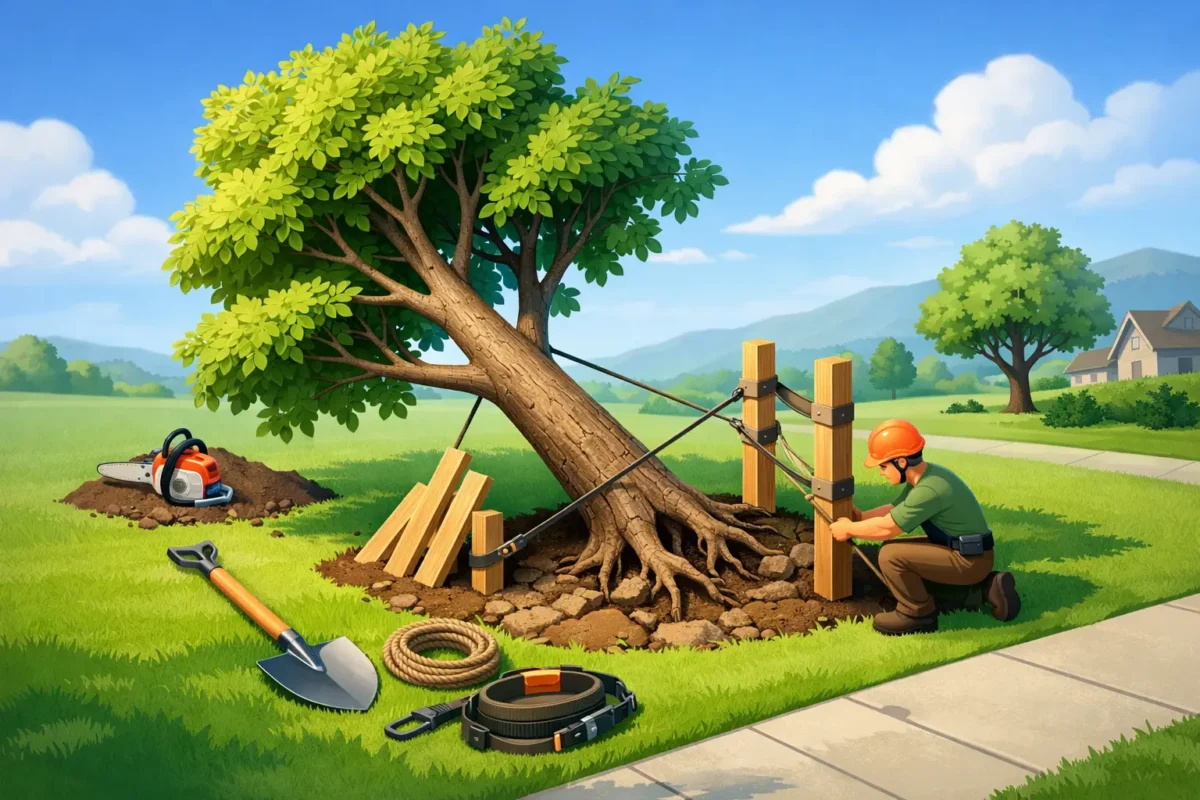
A tree has a better chance if the trunk is sound, the bark is intact, and the root ball has not torn badly out of the ground. If the canopy still looks healthy and the tree can be gently repositioned without forcing it, staking may help while the roots reestablish. Corrective pruning can also reduce weight on the side pulling the tree off balance.
In these cases, speed matters. The longer a recently shifted tree stays out of position, the lower the chance of successful recovery. Roots dry out, stabilize in the wrong position, or continue to fail.
Even then, saving the tree is not guaranteed. Support systems need to be installed correctly, and they should not stay on forever. Poor staking can cause rubbing, girdling, or weak development. If you are dealing with anything larger than a young tree, it is safer to get a professional assessment before trying to pull it upright.
Signs the tree is more likely dangerous than salvageable
Some warning signs point to removal rather than repair. If you see cracked soil or raised ground on one side of the base, the root plate may be lifting. If major roots are exposed or broken, the tree may not have enough anchoring strength left. A split trunk, deep cavities, fungal growth near the base, or dead upper limbs all raise the risk level.
A sudden lean is one of the biggest red flags. Trees that fail slowly over many years often adapt. Trees that move quickly are telling you something changed. That change is often structural failure.
Location matters just as much as condition. A tree that might stand for another year in a back wooded area is a different risk than one hanging over your roof, sidewalk, tenant parking, or utility lines. If the consequences of failure are high, the threshold for removal is lower.
This is where honest advice matters. A safety-first tree company should tell you when a tree is stable enough to monitor and when waiting is not worth the gamble.
Can you fix a leaning tree yourself?
For a very small, recently planted tree, maybe. If the lean is minor and the roots are not torn, you may be able to straighten it, tamp the soil, water it properly, and use soft ties with stakes for temporary support.
For larger trees, DIY fixes are risky. Pulling on a damaged tree with ropes or equipment can make the failure worse. Digging around the base can damage roots further. And if the tree is already unstable, standing underneath it is dangerous.
Homeowners also tend to focus on what is visible above ground. The real problem is often underground. A tree can look mostly green and still be one storm away from coming down because the roots have let go.
If the tree is close to your home, commercial building, garage, driveway, or neighboring property, this is not the place to guess. Getting it checked early is usually cheaper than dealing with a fallen tree, roof damage, or emergency cleanup after the next storm.
What a professional inspection looks for
A proper evaluation is about more than measuring the angle of the lean. A trained tree professional looks at root stability, trunk integrity, canopy weight, soil condition, and nearby targets. They also ask whether the lean is new, whether there has been recent storm damage, and whether construction or trenching happened near the tree.
You want a practical recommendation, not a scare tactic. Sometimes that means pruning and monitoring. Sometimes it means cabling or staking for a younger tree. Sometimes it means the safest move is removal before the tree fails on its own.
For homeowners and property managers, that kind of straight answer matters. You need to know what needs immediate work and what can wait. Especially after severe weather, fast response can make the difference between a controlled removal and a middle-of-the-night emergency.
When to call right away
Do not wait if the tree started leaning suddenly, the soil is heaving, roots are lifting, or the trunk is cracked. The same goes for any leaning tree touching wires, hanging over occupied areas, or dropping large limbs.
In those situations, keep people away from the area and avoid parking or walking beneath the canopy. If the tree is near your home or access points, treat it as a real hazard until a professional says otherwise.
Companies like AAA Tree Service NY handle these situations with the urgency they deserve – especially when storm damage turns a manageable problem into an immediate threat. The goal is not to remove every leaning tree. The goal is to protect your property and act before the tree makes the decision for you.
The right answer depends on the tree and the risk
So, can a leaning tree be saved? Sometimes, yes. Young trees with minor lean and limited root damage often can. Large trees with sudden movement, root failure, or structural damage often cannot be saved safely.
The key is not waiting too long to find out which one you have. If the lean is new, the tree is near something valuable, or you see signs of root or trunk failure, get it inspected before the next round of wind and rain. A quick, honest assessment now can save you a much bigger problem later.
If you are unsure, trust what the tree is showing you. Trees usually give warnings before they fail. The safest move is to take those warnings seriously while you still have options.