8 Top Signs of Internal Tree Decay

A tree can look solid from the street and still be weak where it matters most. That is why knowing the top signs of internal tree decay can help you act before a heavy limb drops on your roof, a trunk splits, or the next storm turns a manageable problem into an emergency.
Internal decay is tricky because you usually do not see the worst damage right away. It often starts inside the trunk, at the base, or where a major limb joins the main stem. By the time the outside shows obvious damage, the tree may already have lost a lot of strength. Some trees can live with a hollow area for years. Others become unsafe much faster. It depends on the species, the size of the defect, the tree’s location, and what could be hit if it fails.
Why internal decay matters more than most property owners think
A decaying tree is not always a dead tree. It may still leaf out, look green, and seem healthy enough. That is what makes this problem easy to miss. The issue is structural strength, not just appearance.
If a tree is close to your house, driveway, sidewalk, parked cars, power lines, or a neighboring property, internal decay becomes a safety issue and a liability issue. This is especially true in parts of New York where strong wind, snow load, and saturated ground can push a weakened tree past its limit. Waiting for clear proof can cost more than getting it checked early.
Top signs of internal tree decay to watch for
Some warning signs are subtle. Others mean you should stop assuming the tree is safe and get a professional inspection soon.
Fungal growth on the trunk or at the base
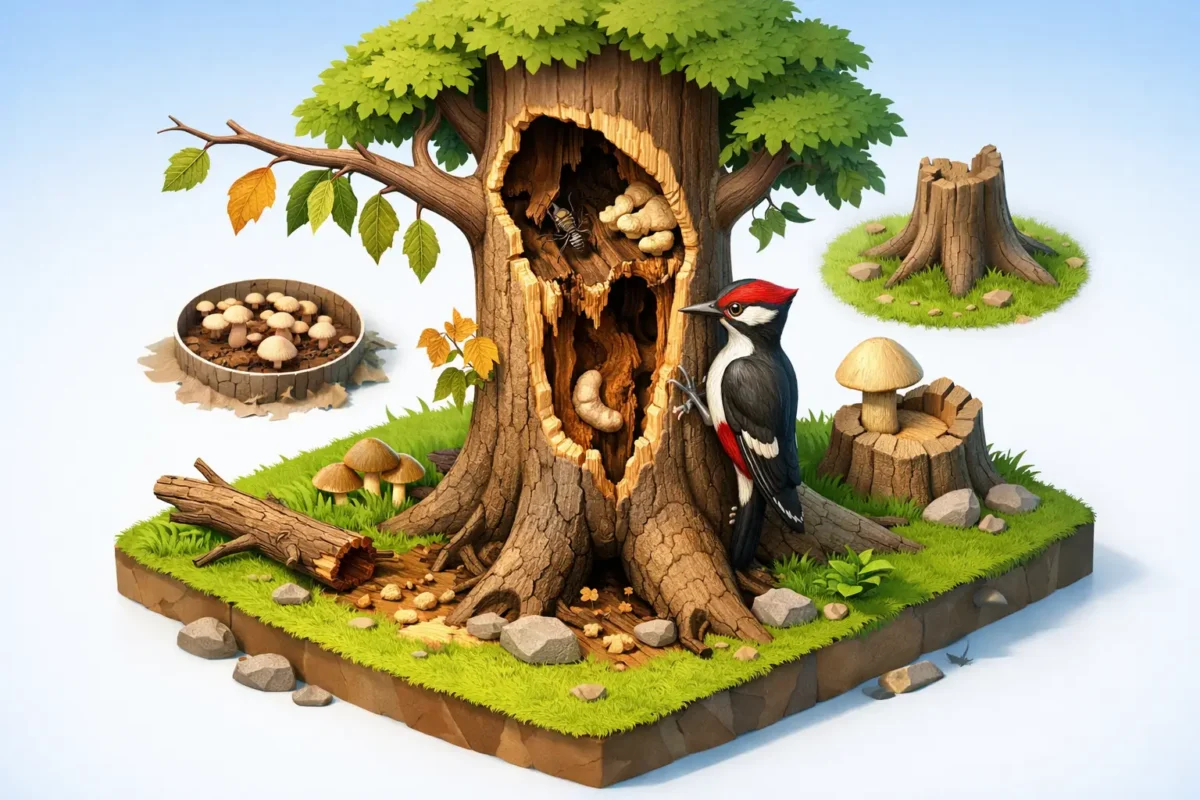
Mushrooms or shelf-like fungi growing from the trunk, root flare, or nearby soil can be one of the clearest signs that wood decay is active. Fungi feed on dead or weakened wood. If you see conks, brackets, or repeated mushroom growth near the same tree, there may be internal rot below the bark.
Not every mushroom means the whole tree is dangerous. Sometimes decay is localized. But when fungal growth appears on a large shade tree near your home, it is worth taking seriously. The fruiting body you see is often just the visible part of a larger problem inside.
Cavities, hollows, or open wounds
A hole in the trunk does not always mean immediate removal, but it should never be ignored. Cavities form when decay progresses long enough to hollow out wood. The bigger the cavity and the less sound wood around it, the greater the concern.
Open wounds from storm damage, poor pruning cuts, old equipment strikes, or split bark can also lead to internal decay. Once the protective outer layer is breached, fungi and moisture have an easier path inside. A tree may try to seal off the area, but it does not always succeed.
Cracked bark, sunken areas, or dead patches
Bark tells you a lot if you know what to look for. Sections that are loose, missing, cracked, or caving inward can point to dead tissue underneath. If the bark sounds hollow when lightly tapped or falls away easily, decay may already be advanced.
Sunken areas on the trunk or a major limb are another red flag. They can mean the wood beneath has started to break down. If that weak spot is paired with a crack, especially where the tree leans over a target area, do not wait for storm season to test it.
Large dead limbs in the upper canopy
When major branches die back while the rest of the tree still has leaves, internal problems may be affecting the tree’s ability to move water and nutrients. Dead limbs can also mean the tree is under severe stress from root damage, disease, or trunk decay.
This does not always mean the trunk is rotting, but it raises concern. If you are seeing repeated dieback in large scaffold branches, especially on a mature tree, the structure needs a closer look. Deadwood over a roof, walkway, or parking area should be addressed quickly.
A sudden lean or soil movement at the base
Some trees naturally grow with a lean and remain stable for years. A new lean is different. If a tree that used to stand straight now appears to tilt, or if the soil around the base is lifting, cracking, or bulging, the roots may be failing.
Internal decay often affects the base of the trunk and root crown, where stability matters most. A hollow trunk with sound-looking branches above can still fail at ground level. If a leaning tree is near your house or a road, treat it as urgent.
Ants, carpenter ants, or insect activity in damaged wood
Insects do not usually cause deep structural decay by themselves, but they often take advantage of it. Carpenter ants, beetles, and other wood-boring insects are commonly found in damp, softened, decaying wood.
If you notice insect trails, sawdust-like material, or steady activity around a cavity or damaged section of trunk, that is a clue the wood may already be breaking down. The insects are not the whole story, but they can point you to where the problem is hiding.
Trunk seams, splits, or weak branch unions
Internal decay weakens the wood fibers that help a tree hold itself together. One result is splitting. A vertical crack in the trunk, a seam that opens and closes, or a major branch union with included bark can become much more dangerous when decay is present inside.
This is one of those situations where appearance can be misleading. The tree may still have a full canopy and seem alive. But if the structure is compromised, wind pressure can turn a crack into a full failure fast.
Excessive woodpecker activity
Woodpeckers are not proof of decay, but they are often drawn to insects living in weakened or rotting wood. If one area of the trunk gets repeated pecking, especially near a dead patch, cavity, or fungal growth, take a closer look.
On its own, this sign is not enough to judge the tree. Combined with other symptoms, it helps build the picture.
What these signs do and do not mean
The top signs of internal tree decay are warning signs, not a full diagnosis. A tree can show one symptom and still be stable enough for pruning, monitoring, or cabling instead of removal. On the other hand, a tree with several moderate symptoms may be high risk because of where it stands.
That is the part many property owners miss. Risk is not just about the tree. It is about the tree plus the target. A decaying tree in the back woods is different from one hanging over your child’s bedroom, your front entrance, or a tenant parking area.
When you should call for a professional inspection
Call sooner rather than later if you see fungal growth at the base, a new lean, a trunk cavity, major dead limbs, or splitting wood. The same goes for any tree that took storm damage and now looks off. Internal decay often speeds up after a tree is wounded.
A professional inspection matters because decay is not always visible from the ground. An experienced tree service can assess the trunk, root flare, canopy balance, load on major limbs, and signs of failure that homeowners often miss. In some cases, the recommendation may be pruning and monitoring. In other cases, removal is the safer and more affordable choice compared with waiting for property damage.
If you are in Albany County, Nassau County, Suffolk County, or another storm-prone service area, it makes sense to have questionable trees checked before high winds, heavy rain, or wet snow arrive. Emergency work is always more stressful when the tree has already hit something.
What not to do if you suspect internal decay
Do not climb the tree, cut heavy limbs yourself, or assume green leaves mean the tree is safe. Avoid parking under it or letting children play nearby until it is inspected. If the tree is leaning, cracking, or dropping large limbs, keep your distance.
This is also not a job for guesswork with a chainsaw. Decayed wood can fail unpredictably. A limb or trunk section may not react the way sound wood does, which makes removal more dangerous than it looks.
The best next step for your property
If you have noticed one or more of these warning signs, trust what you are seeing and get an expert opinion. Honest tree care means not every tree needs to come down, but unsafe trees should not be left standing just because they still look alive. Companies like AAA Tree Service NY handle this kind of risk assessment every day, with the equipment and experience to recommend the safest option for your property.
The right time to deal with possible decay is before the next storm gives you the answer the hard way.