A Homeowner’s Guide to Tree Risk Inspections

A healthy-looking tree can still fail when heavy rain softens the soil, wind loads up the canopy, or snow and ice add weight to a weak limb. That is why a guide to tree risk inspections should start with one rule: do not wait until a branch is on your roof to look closely at the trees around your property.
A tree risk inspection is not about removing every mature tree near a home or parking area. It is about identifying which trees or limbs could realistically hurt someone, damage a building, block access, or hit power lines – and deciding what action makes sense before the next storm. Sometimes the answer is pruning. Sometimes it is monitoring. In higher-risk cases, removal is the safest call.
What a tree risk inspection actually looks for
Tree risk comes down to three factors: the condition of the tree, the likelihood that it will fail, and what it could hit if it does. A dead limb high over an unused wooded area is different from a dead limb over your driveway, front entrance, patio, or commercial parking lot.
A professional inspection begins from the ground. The inspector looks at the trunk, root flare, branches, canopy, surrounding soil, and nearby targets such as homes, vehicles, sheds, sidewalks, fences, and utility lines. They also consider recent weather, past construction, drainage changes, and signs that the tree has been damaged over time.
You do not need to know technical tree terms to recognize that something has changed. Your job as a property owner is to notice warning signs early and call for help before a manageable issue becomes emergency tree removal.
Warning signs you can spot from the ground
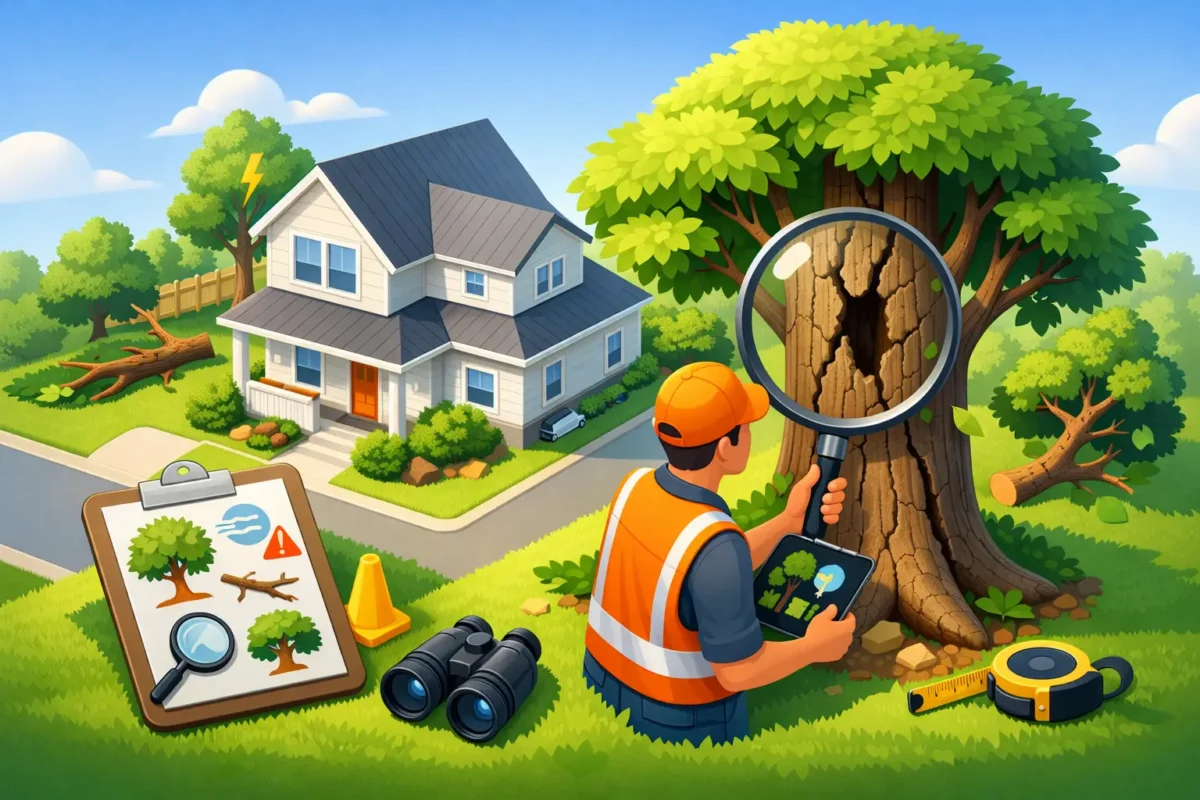
Walk your property after major storms and at least once each season. Stay on the ground and look up, around, and at the base of each large tree. Never climb a tree, use a ladder to inspect limbs, or pull on a cracked branch.
The following signs deserve attention, especially when the tree is close to a structure or gathering area:
- Dead, broken, hanging, or cracked branches in the canopy
- A tree that has recently started leaning or has a lean that appears worse after rain or wind
- Deep cracks, splits, cavities, or missing bark on the trunk
- Mushrooms or fungal growth at the base of the tree or on major roots
- Soil that is lifted, cracked, or heaving on one side of the tree
- Exposed, cut, damaged, or decaying roots
- Multiple trunks with a narrow, V-shaped connection or visible split between them
- A sparse canopy, unusually small leaves, or dead sections on one side of the tree
No single sign automatically means a tree will fall. For example, some mature trees naturally lean and remain stable for years. A cavity may also be less serious than it looks if enough sound wood remains around it. But changes in a tree’s condition, particularly after a storm, should be checked by an experienced tree professional.
Pay close attention to the base
Many homeowners focus on branches because those are easy to see. The root zone often tells the more urgent story. A tree can have a full green canopy while its root system is compromised by decay, saturated soil, trenching, driveway work, or grade changes.
Look for new gaps between soil and roots, raised ground on one side of the trunk, fresh cracks in the soil, or roots that appear to be pulling out of the ground. If a tree shifts after a storm, keep people and vehicles away from the area. It may be unstable even if it has not fallen yet.
Check branch unions and heavy limbs
Where two trunks or large stems meet, inspect for a tight V-shaped union, bark caught in the seam, or a visible crack. These weak connections can split under snow, ice, or high winds. Large horizontal limbs that stretch toward a roof, driveway, or neighbor’s property should also be assessed for deadwood, decay, and excessive weight at the ends.
Proper pruning can reduce weight and remove hazardous limbs without stripping a tree or ruining its shape. Topping, which means cutting major limbs back to stubs, is not a safe fix. It often causes weak regrowth and can create bigger problems later.
When a tree issue is an emergency
Some tree problems can wait for a scheduled estimate. Others require fast action. Treat the situation as urgent if a tree or large limb is leaning against a structure, hanging over a main entrance, blocking a driveway, resting on a vehicle, or actively moving at the root plate.
Call emergency services first if a tree has brought down power lines, is touching electrical equipment, or has created an immediate danger to people. Keep everyone well away. Do not touch the tree, the wires, puddles nearby, or anything the wires may be touching. Do not attempt to cut or move the tree yourself.
For storm damage that does not involve active utility danger, a 24/7 tree service can secure the area, remove dangerous sections, and help restore safe access. Take photos from a safe distance for insurance documentation, but do not step under a suspended limb to get a better picture.
How weather and property changes affect risk
In New York, freeze-thaw cycles, heavy snow, ice, high winds, and saturated spring soil all put pressure on trees. A limb that held up last winter may not hold up after another season of decay. Likewise, a tree that seemed stable during dry weather can become vulnerable when persistent rain softens the ground.
Construction can also change the picture. Root damage from excavation, compacted soil from equipment, a new driveway, or altered drainage may affect a tree months or even years later. If you have recently completed landscaping or building work near mature trees, include those trees in your next inspection.
For commercial properties, inspect trees along sidewalks, entrances, loading areas, tenant parking, and signs. The concern is not only property damage. A failing limb over a place where employees, customers, or delivery drivers walk creates a safety and liability issue that should not be ignored.
What happens after a professional inspection
An honest inspection should not end with pressure to remove every tree. The recommended work should match the actual risk and your property’s use. A qualified tree service may recommend pruning deadwood, reducing a long heavy limb, installing support hardware in limited cases, clearing a hazardous tree, or simply monitoring a condition over time.
Ask what the crew found, what could happen if no work is done, and how soon the work should be scheduled. You should also ask whether the company is licensed and insured, how the work area will be protected, and whether debris and wood will be removed. A clear answer is a good sign that you are getting practical advice rather than a sales pitch.
At AAA Tree Service NY, the goal is to help you address real hazards without recommending work your property does not need. With more than 26 years of experience and emergency availability, the team can assess storm-damaged trees, dead limbs, leaning trunks, and routine maintenance concerns with safety first.
How often should you inspect your trees?
For most residential properties, a visual check twice a year is a sensible starting point: once after winter and once before the main storm season. Also inspect after strong winds, heavy wet snow, ice storms, flooding, or any event that leaves branches on the ground.
Schedule a professional inspection sooner if you notice a new lean, root movement, trunk cracking, major deadwood, or a branch hanging over a target. Older trees near your house deserve more frequent attention than trees at the back of a large lot where nothing is within reach.
The best time to address a tree hazard is when the crew can work safely, the tree is still stable, and you have options. A free estimate today may prevent a blocked driveway, damaged roof, or middle-of-the-night emergency after the next storm.