How to Prepare Trees for Storms

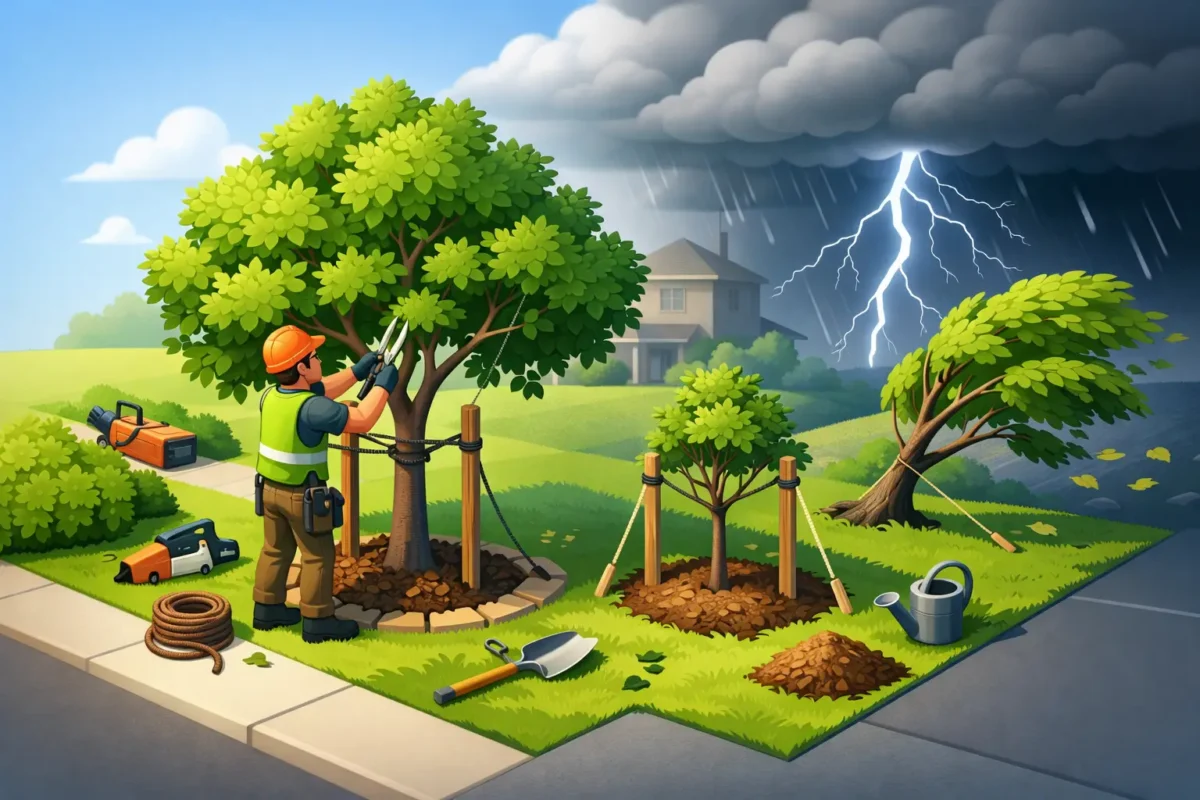
A tree usually gives you plenty of warning before it fails in a storm. The problem is most property owners do not know what they are seeing until a heavy wind or wet snow brings a limb down on the driveway, roof, fence, or power line. If you are wondering how to prepare trees for storms, the right time is before the weather turns, not after branches are already on the ground.
Storm prep for trees is not about cutting everything back hard and hoping for the best. In many cases, over-pruning makes a tree weaker, not safer. What helps is a practical look at tree condition, branch structure, dead wood, root stability, and how close the tree is to your home, cars, walkways, or neighboring property.
How to prepare trees for storms without overcutting
The first step is knowing which trees actually need attention. A healthy, well-shaped tree can often handle normal wind better than a neglected one with dead limbs, split unions, or root problems. That is why storm prep starts with inspection, not random cutting.
Walk your property and look up as much as you look around. Dead branches are one of the biggest hazards because they snap easily under wind, ice, or heavy rain. If you see limbs with no leaves during growing season, peeling bark, hollow sections, or visible decay, those branches should be evaluated quickly.
Leaning is another warning sign, but it depends on the situation. Some trees naturally grow with a slight lean and stay stable for years. What matters is whether the lean is new, getting worse, or paired with cracked soil, exposed roots, or lifting ground near the base. That can point to root failure, and that is a storm emergency waiting to happen.
You should also pay attention to branch unions, especially where two large stems meet in a tight V-shape. These weak attachments are more likely to split in high winds. If the tree is hanging over a roof, driveway, sidewalk, or parking area, the risk is not just tree damage. It is property damage and liability.
The trees that deserve the fastest attention
Not every issue needs same-day work, but some problems should move to the top of your list. A dead tree near a home, a cracked limb over a driveway, or a tree touching utility lines should not wait for the next storm alert. The same goes for trees with major decay at the trunk base or large limbs already broken and hanging.
On the other hand, a healthy tree that simply has a few lower limbs brushing over the lawn may not be urgent. This is where honest recommendations matter. Good storm prep is about reducing real risk, not removing every branch just because weather is part of life in New York.
In areas like Albany County, Nassau County, Suffolk County, and other parts of New York where wind, ice, and heavy wet snow can hit hard, weak trees tend to fail at the same predictable points. Deadwood, overextended limbs, and compromised root systems are usually the first to go.
Pruning for storm resistance
Proper pruning helps a tree move better in the wind. It reduces excess weight, removes weak or dead limbs, and improves branch spacing. But there is a right way to do it and a wrong way.
The wrong way is topping, severe cutbacks, or stripping out too much live growth at once. Topping leaves trees stressed and unstable. It often leads to fast, weak regrowth that fails more easily in the next storm. If someone recommends cutting the entire crown back just to make the tree shorter, that should raise questions.
The right approach is selective pruning. Dead, damaged, crossing, and poorly attached branches are the first targets. In some cases, thinning a dense canopy can help reduce wind resistance, but this should be done carefully. Too much thinning can expose the tree to more stress and sun damage.
Mature trees especially need restraint. You are not trying to force a big old tree into a small-tree shape. You are trying to improve structure and reduce obvious hazards while keeping the tree healthy enough to recover from bad weather.
Do not ignore the root zone
A lot of storm failures start below ground. A tree with compromised roots can look fine until saturated soil and strong wind work together. Then the whole tree can go over.
Watch for signs like mushrooms at the base, soft or hollow spots near the trunk, root damage from trenching or construction, and soil heaving after storms. Repeated traffic over the root area can also compact the soil and weaken tree health over time.
Mulch helps more than many people realize. A proper mulch ring around the base can protect roots from mower damage, hold moisture more evenly, and improve soil conditions. Keep mulch away from direct contact with the trunk. Piling it against the bark can trap moisture and invite decay.
If you recently had excavation, a new patio installed, or grading work done near a large tree, that tree deserves extra attention before storm season. Root loss does not always show up right away in the canopy.
Common mistakes homeowners make before storms
One common mistake is waiting until a storm warning is already in effect. At that point, the safest option may be to stay clear and call for help after the storm passes. Tree work in active severe weather is dangerous, and not every issue can be fixed at the last minute.
Another mistake is assuming every tree problem is visible from the ground. Some defects are easy to miss unless you know what to look for. Internal decay, weak attachments high in the canopy, and storm cracks can stay hidden until failure happens.
The third mistake is treating tree work like basic yard work. Small pruning from the ground may be manageable in some cases, but climbing, cutting large limbs, or working near structures and service lines is a serious safety risk. A falling branch does not need to be huge to cause expensive damage or a severe injury.
When to call a professional
You should call a professional if a tree is leaning toward a structure, dropping large dead limbs, showing visible cracks, or growing close to power lines. The same applies if you are unsure whether a tree is stable after a storm. Uncertainty is reason enough when the consequence could be major damage.
A licensed and insured tree service can tell you whether a tree needs pruning, cabling, removal, or simple monitoring. That matters because the answer is not always removal. Some trees can be made much safer with targeted work. Others are too compromised and should come down before they fail on their own.
For homeowners and small commercial property owners, this is often where cost and risk meet. Preventive trimming is usually far less expensive than emergency removal, roof repair, fence replacement, or cleanup after a large limb comes down at 2 a.m. If a tree already shows clear warning signs, delaying the work rarely makes it cheaper.
A storm prep plan that actually works
If you want a practical way to prepare, start with the trees closest to what matters most – your house, garage, parked vehicles, entrance paths, play areas, and neighboring lines. Those trees get first priority because the consequences of failure are highest.
Then look at timing. Late winter and early spring are often good times for inspection and pruning, but storm prep is not limited to one season. Dead limbs, splits, and hanging branches should be addressed whenever you spot them. After major wind, snow, or ice, inspect again. Storm damage often creates new weak points that are not obvious from a distance.
Take photos if you notice a change. A tree that is suddenly leaning more, cracking at the trunk, or dropping larger pieces over time is telling you something. Documenting that change helps a professional assess urgency.
If you have not had your high-risk trees evaluated in years, now is the time. Companies like AAA Tree Service NY often see the same pattern after severe weather – property owners knew a tree looked questionable, but hoped it would make it through one more season. Sometimes it does. Sometimes it lands where your family parks or where customers walk.
Storms are unpredictable. Tree hazards usually are not. If something on your property looks off, sounds hollow, leans more than it used to, or hangs over the places you cannot afford to lose, get it checked before the next round of wind tests it for you.