How to Prune Trees Properly and Safely

That low branch scraping your roof is not just annoying. It is a warning sign. The same goes for dead limbs over a driveway, branches crowding power lines, or a tree with heavy growth pulling to one side. If you are wondering how to prune trees properly, the goal is not to make a tree look neat for a week. The goal is to reduce risk, protect the tree’s health, and avoid the kind of damage that shows up after the next storm.
Pruning sounds simple until one bad cut leaves a tree stressed, unbalanced, or vulnerable to decay. Homeowners often wait too long, cut too much, or trim the wrong branch in the wrong place. That can turn routine maintenance into a costly problem. Done correctly, pruning removes weak, dead, damaged, or poorly placed limbs while helping the tree keep a strong structure.
Why proper pruning matters more than most homeowners think
A tree does not heal the way skin does. Every cut creates a wound, and the tree has to seal that wound off over time. If the cut is too large, too deep, or made in the wrong spot, decay can move into the branch or trunk. That is why proper pruning is less about cutting more and more about cutting with a purpose.
Safety is a big part of it. Deadwood can fall without much warning, especially after wind, ice, or heavy rain. Branches that overhang roofs, garages, walkways, and parked cars deserve attention before they become emergency calls. For property owners, pruning is also about liability. A neglected tree can damage structures, vehicles, fences, and power service, and it can injure people.
There is also the health side. Removing broken, rubbing, diseased, or crowded branches can improve airflow and light penetration. That helps many trees grow with fewer structural problems over time. But there is a trade-off. Over-pruning can weaken the tree, trigger stress growth, and make it more vulnerable to insects, sunscald, or storm breakage. More cutting is not better.
How to prune trees properly without harming them
The first rule is simple: know what you are removing and why. Every cut should solve a problem. If a branch is dead, cracked, diseased, crossing another branch, growing inward, or creating a clearance issue, it may need to go. If it is healthy and well-placed, leave it alone.
Start by looking for the branch collar, which is the slightly swollen area where the branch meets the trunk or a larger limb. This is the area you want to preserve. Cuts should be made just outside the branch collar, not flush against the trunk and not several inches away leaving a stub. Flush cuts damage the tree’s natural defense system. Stub cuts die back and invite decay.
For small branches, a clean cut with sharp hand pruners or loppers is usually enough. For larger limbs, use the three-cut method to prevent bark tearing. Make the first cut on the underside of the branch a short distance from the trunk. Make the second cut from the top slightly farther out until the branch drops. Then make the final cut just outside the branch collar. This prevents the weight of the limb from ripping bark down the trunk.
A good pruning job also respects balance. If all the cuts are on one side, the canopy can become uneven. If too much growth is removed from the outer ends, the tree may respond with weak, fast-growing shoots. If the top is cut back harshly, the result is often ugly regrowth and a structurally weaker tree.
When to prune and when to leave the tree alone
Timing matters. For many shade trees, the dormant season from late winter to early spring is often the best time for structural pruning. The branch framework is easier to see, the tree is under less stress, and spring growth can help seal cuts.
That said, dead, broken, or hazardous limbs should be removed whenever they are found. Waiting for the perfect season does not make sense when a branch is hanging over your house. Storm-damaged trees are a separate issue. In those cases, safety comes first.
Some trees have specific timing needs. Flowering trees may lose buds if pruned at the wrong time. Oaks may need extra caution in areas where disease spread is a concern. Maples and birches can bleed sap if pruned in late winter, which looks alarming but is usually not harmful. This is one of those it depends situations. The right time to prune can vary by species, condition, and the reason for the cut.
In New York, pruning before storm season can make a real difference for homeowners. Heavy limbs over roofs, weak branch unions, and crowded canopies are all trouble when wind, wet snow, or ice hits. Routine pruning is cheaper than emergency removal after a tree splits.
Common pruning mistakes that create bigger problems
Topping is one of the worst. This is when large upright sections of the canopy are cut back bluntly to reduce height. It may seem like a quick fix for an oversized tree, but it usually leads to weak new shoots, larger wounds, more decay, and a tree that becomes more dangerous over time.
Another mistake is removing too much at once. As a general rule, taking off more than about a quarter of the live canopy in one season can stress many trees. Younger trees may tolerate structural pruning better than mature ones, but even then, restraint matters.
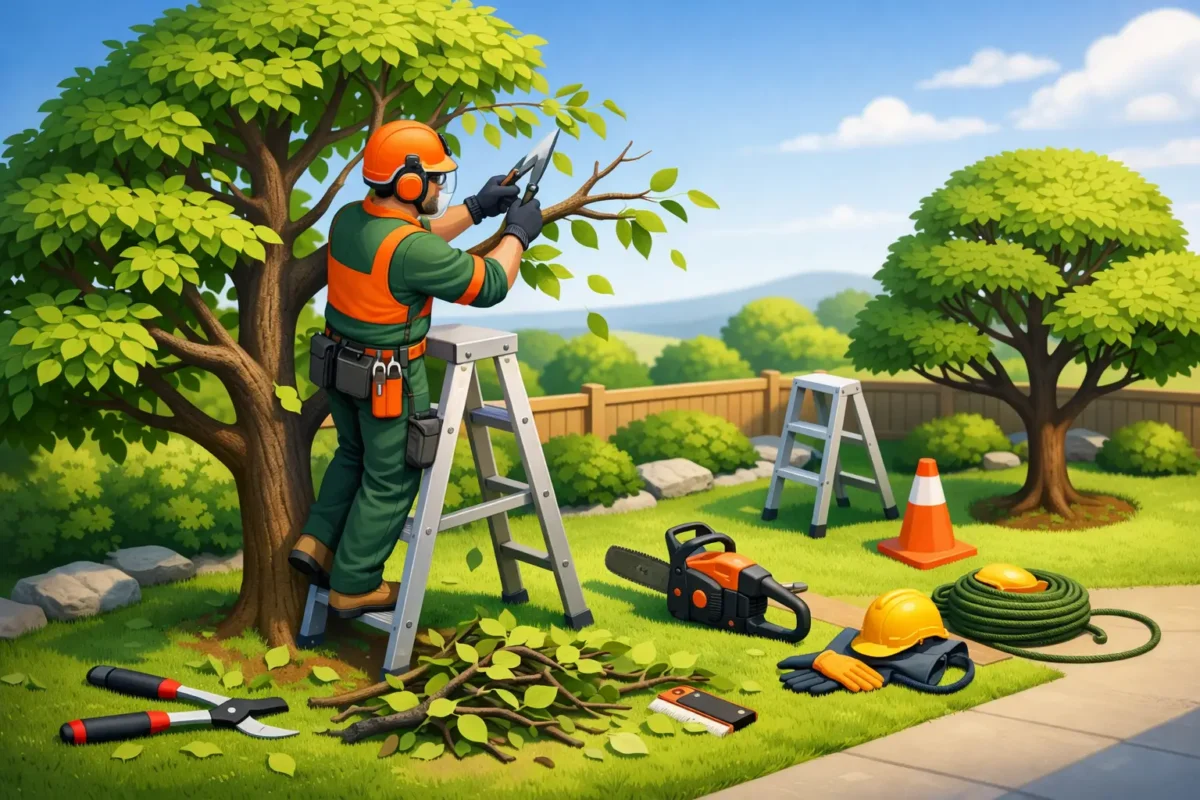
Homeowners also run into trouble by using dull tools, making flush cuts, or leaving stubs. Climbing ladders with saws is another serious risk. Many injuries happen when people try to cut limbs overhead or near service lines. If a branch is large, high, storm-damaged, or close to a house, that is not routine yard work anymore.
What branches should usually be pruned first
If you are trying to decide where to begin, start with the obvious hazards. Remove dead, hanging, cracked, or broken limbs first. Then look for branches that cross and rub, because those wounds can become entry points for disease and decay.
After that, check for branches growing inward toward the center of the tree, low limbs blocking safe access, and limbs too close to roofs, siding, chimneys, or windows. On younger trees, it is smart to correct structural issues early, such as competing leaders or narrow branch angles. Early pruning can prevent a future split.
What you should not do is strip out the interior just to make the tree look open. Trees need foliage to produce energy. The idea is selective improvement, not thinning for the sake of thinning.
Knowing when proper pruning requires a professional
Some pruning jobs are simply not safe for a homeowner. If the tree is large, leaning, storm-damaged, near power lines, or dropping limbs over occupied areas, call a professional. The same goes for trees with decay, trunk cracks, root problems, or branches that require climbing and rigging.
This is where experience matters. A trained crew can spot defects that are easy to miss from the ground, such as included bark, split unions, cavity development, and hidden deadwood. They can also tell you when pruning will help and when a tree is already too compromised to save. Honest advice matters because not every tree should be cut back and not every damaged tree needs full removal.
For homeowners and property managers, the smart move is to act before conditions get worse. A free estimate is a lot easier to deal with than storm damage in the middle of the night. Companies like AAA Tree Service NY often see the same pattern: a branch gets ignored, weather hits, and a preventable maintenance issue turns into an emergency.
A practical approach to tree pruning that protects your property
If the branch is within reach from the ground, small, clearly dead or damaged, and far from utilities or structures, careful pruning may be manageable. Use the right tool, make the cut outside the branch collar, and remove only what serves a clear purpose.
If the branch is heavy, elevated, tangled, or over anything you cannot afford to damage, stop there. Trees can fail suddenly when weight shifts. One wrong cut can send a limb into a roof, fence, or car, or pull the person cutting it off balance.
The best pruning decisions are usually the least dramatic ones. Remove the hazard. Preserve the structure. Do not cut just because the tree looks too full. And if you see deadwood, storm damage, a growing lean, or limbs over the house, do not put it off until the next high wind warning. A little attention now can spare you a much bigger problem later.