Is Tree Trimming and Pruning the Same Thing?

A lot of property owners ask the same question after spotting overgrown limbs or dead branches near the house: is tree trimming and pruning the same thing? The short answer is no. People often use the terms interchangeably, but they are not exactly the same job, and knowing the difference can help you avoid property damage, unsafe limbs, and unnecessary work.
If a branch is hanging over your roof, brushing power lines, or starting to crack after a storm, the wording matters less than getting it addressed fast. But if you want healthier trees, better structure, and fewer surprises during the next heavy wind or snow event, it helps to understand what each service is meant to do.
Is tree trimming and pruning the same thing in practice?
In everyday conversation, many homeowners say trimming when they mean pruning, and many contractors hear both terms all the time. That is normal. Still, there is a practical difference.
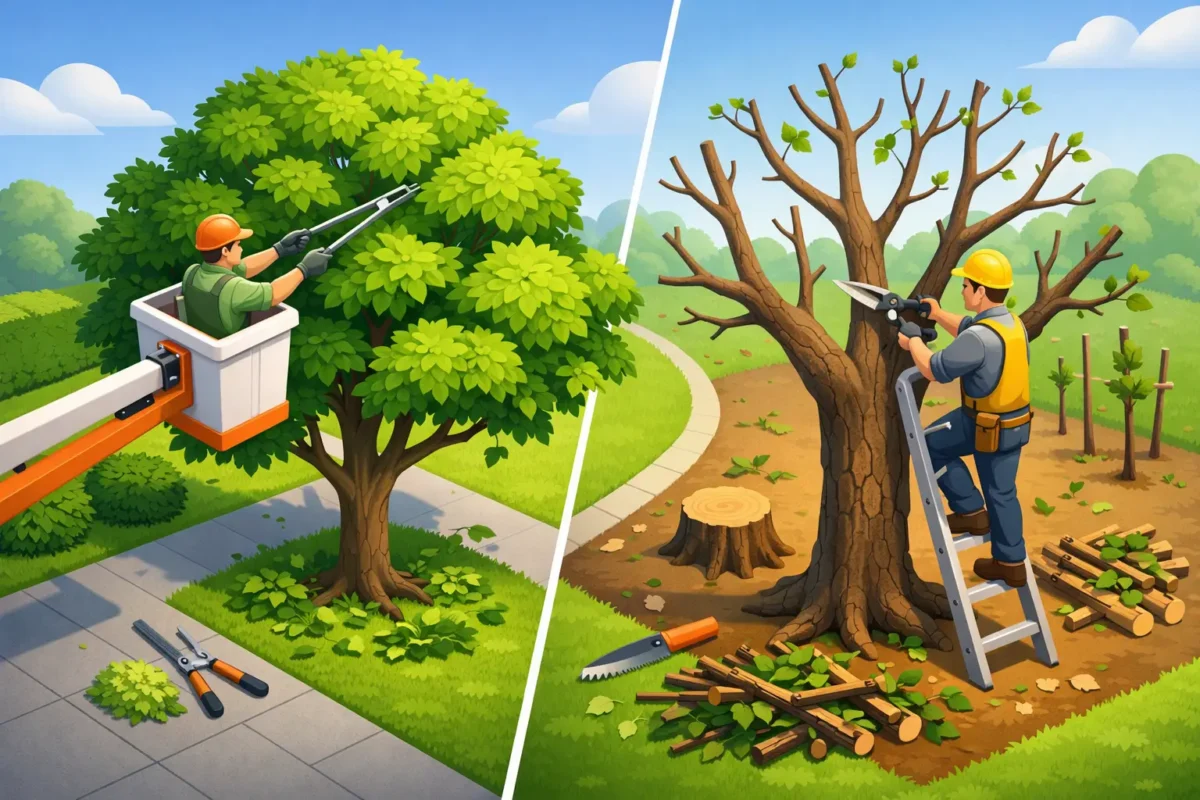
Tree trimming usually refers to cutting back overgrown branches to improve size, shape, and clearance. It is often done to keep limbs away from roofs, siding, driveways, walkways, fences, and neighboring properties. It can also improve sunlight and make a tree look cleaner and more balanced.
Tree pruning is more selective. The goal is usually tree health, safety, and structure. Pruning focuses on removing dead, diseased, weak, crossing, or poorly attached branches. It may also be used to guide the tree’s growth so it develops a stronger form over time.
That means trimming is often about management and appearance, while pruning is more about long-term health and risk reduction. The two services overlap, but they are not identical.
Why the difference matters to homeowners
If your only goal is to make a tree look neater, trimming may be enough. But if the tree has deadwood, storm damage, rubbing limbs, decay, or branches with weak unions, simple trimming does not solve the real problem.
This is where many costly mistakes start. A tree can look cleaner after a few cuts and still remain dangerous. Dead limbs over a driveway do not become safe just because the canopy looks tidier. A tree leaning toward the house does not become stable because some outer growth was removed.
For homeowners and building owners, the bigger issue is liability. If a neglected branch falls on a car, roof, shed, or sidewalk, the damage can escalate fast. In places like Albany County, Nassau County, Suffolk County, and other New York service areas where storms, wet snow, and high winds are common, preventive tree care is not just cosmetic. It is a way to reduce risk before the next weather event hits.
What tree trimming usually includes
Tree trimming is commonly used when a tree has outgrown its space or is interfering with the property. That could mean branches hitting the home, blocking signs, crowding a parking area, or hanging too low over a walkway.
A proper trimming job should improve clearance without stripping the tree or leaving it unbalanced. Good trimming accounts for weight distribution, branch spacing, and how the tree will respond after cuts are made. Cutting too much at once can stress the tree and trigger weak regrowth.
This is why aggressive cutting is not always a smart move, even when the tree looks overgrown. Homeowners sometimes ask for everything cut way back, thinking that more removal means less future trouble. In reality, over-trimming can create more problems, including sun damage, decay, and unstable new shoots.
What pruning is really meant to do
Pruning is a more targeted service. It removes specific branches for a reason, not just to reduce size. That reason may be deadwood removal, disease control, storm damage correction, structural training, or weight reduction on a stressed limb.
For younger trees, pruning can shape stronger branch structure early on. That matters because poor early growth often turns into expensive problems later. For mature trees, pruning can reduce hazards and help preserve the tree instead of removing it.
Pruning also calls for better timing in many cases. Some species respond best at certain times of year, while others should not be cut heavily during active growth or disease-prone periods. It depends on the tree, its condition, and the reason for the work.
Signs you need pruning, not just trimming
If you see dead limbs, cracked branches, hollow areas, fungus growth near the trunk, limbs rubbing together, or a canopy with uneven weight, pruning is usually the more accurate need. The same is true if a tree has storm damage or a history of dropping limbs.
Another warning sign is when the problem is inside the canopy, not just at the edges. Trimming often deals with outside growth and clearance. Pruning addresses internal issues that can weaken the tree or make it unsafe.
If you are unsure, that is exactly when an honest assessment matters. A trustworthy tree service should explain whether your tree needs simple maintenance, selective pruning, or removal if the risk is too high. You should never be pushed into extra work that does not match the condition of the tree.
Is one service more expensive than the other?
Sometimes pruning costs more because it takes more judgment and more careful cuts. It is not always about how much wood is removed. It is about where the cuts are made and why.
Trimming can be straightforward when the goal is basic clearance. Pruning may involve climbing deeper into the canopy, identifying weak branch attachments, reducing end weight, and preserving the health of the tree at the same time. That takes skill.
But cost should not be the only factor. A cheaper job that removes the wrong branches can leave you with a stressed tree and a bigger bill later. Poor cuts can also increase the odds of storm failure, decay, or emergency removal.
The risk of treating all tree cutting the same
One of the biggest mistakes property owners make is assuming all branch removal is equal. It is not. Topping a tree, removing too much canopy, or cutting branches in the wrong place can weaken the tree fast.
Bad cuts do more than hurt appearance. They can leave wounds that do not close properly, invite pests or disease, and create weak regrowth that breaks more easily. The result is a tree that may look smaller for now but becomes more dangerous over time.
This matters even more around homes, apartment buildings, driveways, and commercial properties. A poorly maintained tree near a structure is not just a yard issue. It is a safety issue.
When timing matters most
If a limb is cracked, hanging, or storm-damaged, waiting is a mistake. That is an immediate safety issue, not a seasonal maintenance question. Emergency work should be handled as quickly as possible to prevent damage to people or property.
For non-emergency care, timing depends on the species, the tree’s health, and your goal. Some trees are best pruned during dormancy. Others may need light corrective work at different times of year. And sometimes the right answer is to delay non-urgent cutting if the tree is already stressed by drought, pests, or recent damage.
That is why a one-size-fits-all answer does not work. The right service at the wrong time can still create problems.
So what should you ask for?
If you are calling a tree service, do not worry too much about using perfect terminology. Describe what you see. Mention dead limbs, overgrowth, branches on the roof, storm damage, leaning, cracking, or blocked access. A good company will tell you whether the tree needs trimming, pruning, or something more serious.
What you do want to ask is whether the work is being recommended for appearance, clearance, health, or safety. That question gets to the real issue fast.
For example, if the branch is scraping your house, trimming may solve it. If the branch is split and failing, pruning or removal may be the safer answer. If the tree has widespread decay, neither trimming nor pruning may be enough.
At AAA Tree Service NY, that kind of practical risk assessment matters because the goal is not to sell extra cutting. The goal is to help property owners act before small tree issues turn into major damage.
The real answer homeowners need
So, is tree trimming and pruning the same thing? Not exactly. Trimming usually manages growth, shape, and clearance. Pruning is more selective and focuses on health, structure, and hazard reduction.
Both have a place. Both can protect your property when done correctly. But when a tree is showing warning signs like dead limbs, storm damage, or unstable growth, you do not want a cosmetic fix when the real problem is safety.
If something looks off, trust that instinct and get it checked before the next storm tests it for you.