How to Inspect Leaning Trees Safely

A tree that suddenly leans after heavy rain or wind is not something to watch for a few weeks. It is a warning sign. If you are wondering how to inspect leaning trees, the first goal is simple – figure out whether the tree is stable enough to monitor or dangerous enough to call for immediate help.
Some trees naturally grow at an angle and stay that way for years. Others start leaning because roots are failing, soil is shifting, or the trunk has cracked under stress. The problem is that from the ground, both situations can look similar at first. That is why a careful visual inspection matters, especially before the next storm turns a questionable tree into a property damage claim.
How to Inspect Leaning Trees Without Taking Risks
Start from a safe distance. Do not stand directly under the canopy, and do not walk close to the base if the tree looks freshly tilted, if the soil is lifting, or if you see cracks in the ground. A leaning tree can fail with very little warning.
Begin by asking one question: has this tree always leaned like this? If the angle looks new, or if neighbors or family members say it changed after a storm, treat that as a serious red flag. A new lean often points to root movement, trunk failure, or soil instability.
Next, look at the lean itself. A slight lean in a healthy tree is not always an emergency. A sudden lean, a worsening lean, or a tree pointing toward a house, driveway, sidewalk, parked cars, or utility lines raises the risk immediately. The inspection is not just about the tree. It is about what it could hit if it fails.
Check the Base First
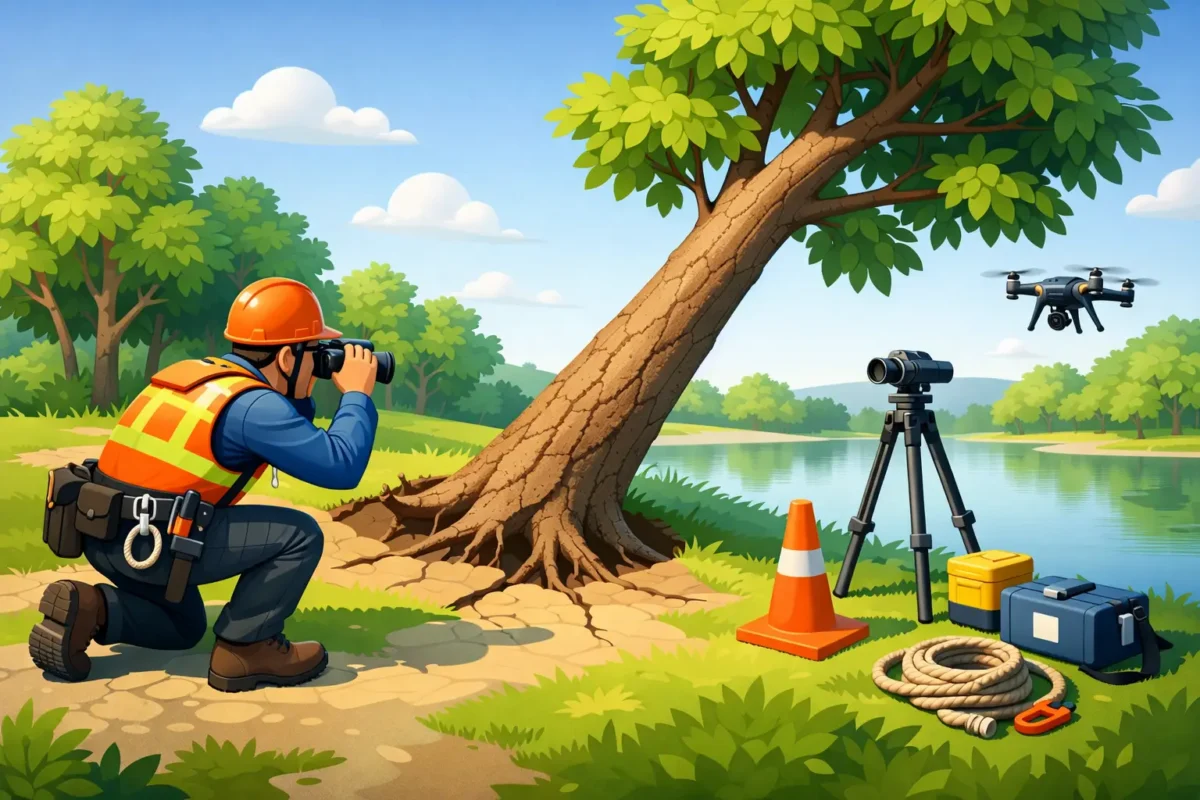
The base of the tree usually tells the real story. Look for soil heaving, which means the ground on one side of the trunk is lifting or mounding up. That can signal the root plate is starting to pull out of the ground. If the tree recently leaned and the soil around the roots looks cracked, raised, or loose, stop there and call a professional.
You should also look for exposed roots, broken roots, or fungal growth around the base. Mushrooms near the trunk do not always mean the tree is failing, but they can point to internal decay in the roots or lower stem. Soft wood, hollow spots, or areas that crumble when lightly touched are not minor issues.
If the tree is planted in saturated soil, be even more cautious. In parts of New York, long periods of rain followed by wind can leave trees standing in unstable ground. A tree may still be upright enough to look safe while the roots are already losing their grip.
Inspect the Trunk for Stress and Failure
After the base, study the trunk from bottom to top. You are looking for vertical cracks, splitting bark, cavities, seams, and places where the wood appears twisted or compressed. A trunk under stress often shows long cracks or fresh wounds where the tree is starting to fail structurally.
Pay close attention to one-sided damage. If the trunk has a deep crack on the side opposite the lean, that can mean the wood fibers are under heavy tension. If bark is peeling away and fresh wood is visible, the tree may already be in the early stages of breaking.
Older wounds matter too, but fresh damage is more urgent. A cavity that has been there for years may or may not be a problem depending on the tree species and how much sound wood remains. A new split after a storm is a different story. That needs fast attention.
Look Up Into the Canopy
A leaning tree with a full, healthy canopy is not automatically safe, but the crown can still give useful clues. Look for dead limbs, hanging branches, sparse leaf growth on one side, or large sections with no leaves during the growing season. Those signs can mean the tree has root loss, internal decay, or declining health.
An uneven canopy also matters. If most of the weight is pulling in the direction of the lean, the tree is under more stress. Large overextended limbs can act like a lever, especially in wind or wet snow. That is often when a tree that looked stable enough finally gives way.
If branches are already cracked or hanging, do not try to remove them yourself from a ladder. Leaning trees and damaged limbs are a dangerous combination, and many homeowner injuries happen during do-it-yourself cleanup after storms.
Warning Signs That Mean Call Now
Some conditions move this from inspection to emergency. If you see roots lifting out of the ground, a trunk split, fresh soil cracking, power lines nearby, or a tree leaning more after a recent storm, do not wait for another opinion from the weather. Get professional help right away.
The same goes for any tree that is leaning toward a structure or over an area where people walk or park. A tree does not have to be fully uprooted to become dangerous. Partial root failure is enough to cause sudden collapse, especially when wind picks up.
For homeowners and property managers, delay is where repair costs climb. The tree that could have been stabilized, trimmed, or removed in a controlled way can become emergency roof damage, fence destruction, vehicle damage, or liability exposure if it falls onto a neighboring property.
When a Lean May Be Less Urgent
Not every leaning tree is on the verge of falling. Some trees develop a natural lean as they reach for sunlight, grow away from competition, or respond to site conditions over time. If the lean is long-standing, the trunk is sound, the roots are stable, and the canopy looks healthy, the situation may be monitorable rather than urgent.
That said, it depends on the tree species, the angle, the soil, the target area, and recent weather. A tree in an open yard is different from a tree hanging over a home. A mild lean in dry, stable ground is different from the same lean in soaked soil after a storm. This is where professional assessment earns its value. Honest tree care is not about pushing removal every time. It is about knowing the difference between manageable risk and immediate danger.
How to Document What You See
If the tree is not in immediate failure, take clear photos from several angles. Capture the full tree, the base, the root area, the trunk, and any visible cracks or dead limbs. Photos help you track whether the lean changes over time, and they also make it easier to explain the issue when you call for an estimate.
You can also note the date of the storm, heavy rainfall, or any sudden changes you observed. If the lean appeared after one weather event, that detail matters. In storm-prone areas across counties like Albany, Nassau, Suffolk, and Orange, weather-related movement is often the turning point from stable to unsafe.
What Not to Do During a Leaning Tree Inspection
Do not climb the tree, tie it off with ropes, cut roots, or start pruning heavy limbs to try to correct the lean yourself. Those actions can shift the load suddenly and make the failure happen faster. Do not park vehicles nearby, and do not let children play around the base while you decide what to do.
Also, do not assume a tree is safe just because it is still standing. Many hazardous trees remain upright right until the moment they fail. What matters is not whether the tree has fallen yet. What matters is whether the structure is compromised.
When to Bring in a Tree Professional
If you are unsure how to inspect leaning trees with confidence, that uncertainty is your answer. A qualified tree professional can assess root stability, trunk strength, canopy load, and surrounding hazards without guesswork. They can also tell you whether the right solution is monitoring, pruning, cabling, or removal.
For urgent situations, speed matters. A safety-first tree company with storm experience can respond faster, secure the area, and recommend only the work the tree actually needs. That is especially important after wind events, when multiple damaged trees may compete for emergency response.
AAA Tree Service NY sees this often – homeowners wait because the tree has not fallen yet, then the next storm finishes the job. If you see a new lean, root lifting, cracking, or dead weight over your home, act before it becomes a bigger and more expensive problem.
A leaning tree is giving you a warning. Listen to it while you still have options.