7 Top Tree Maintenance Mistakes to Avoid

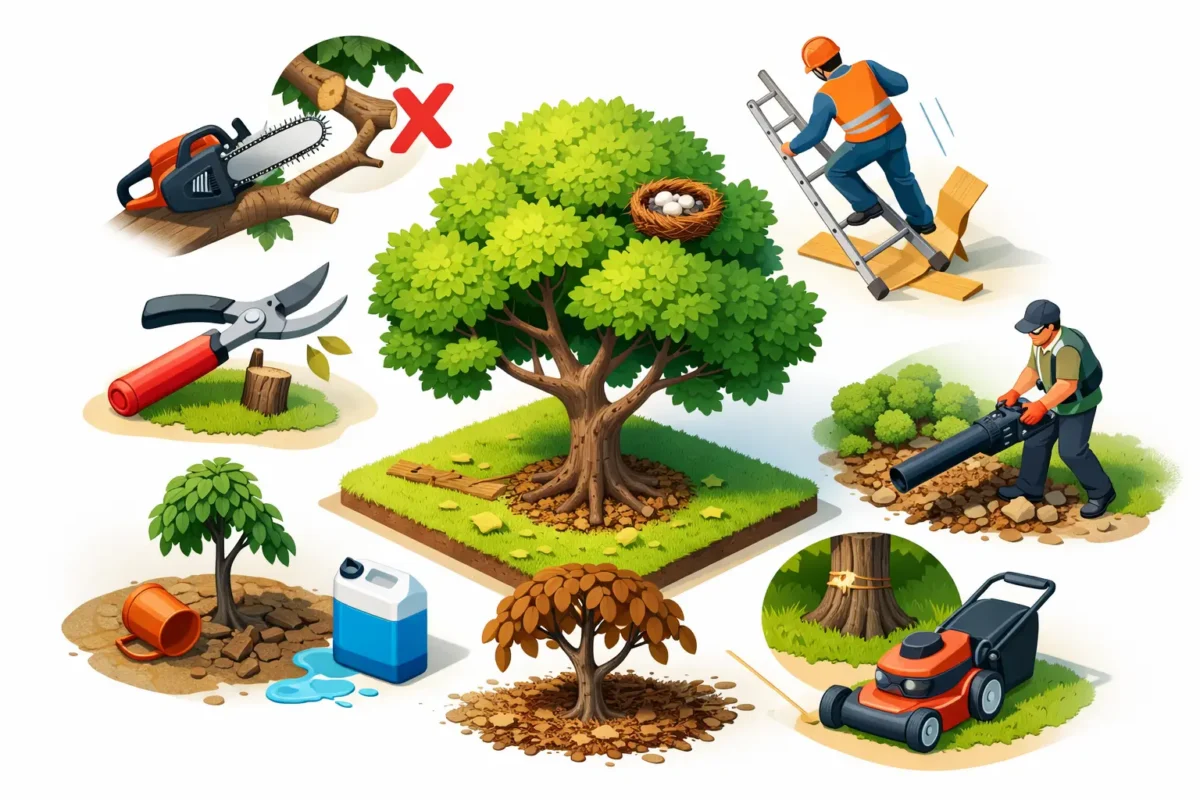
A tree rarely fails all at once. More often, the warning signs sit in plain view for months – a dead limb over the driveway, roots cut during a project, a lean that gets a little worse after each storm. Many of the top tree maintenance mistakes happen when small problems are ignored until they turn into property damage, liability, or an emergency call in bad weather.
If you want to protect your home, your family, and anyone who visits your property, tree care needs to be practical and timely. Not every issue is urgent. But the wrong kind of delay can turn routine maintenance into storm cleanup, roof damage, or a dangerous removal.
The most common top tree maintenance mistakes
Some mistakes come from good intentions. Homeowners try to trim a little themselves, clean up roots, or wait one more season to save money. The problem is that trees respond slowly, and by the time the damage shows up, the repair is harder and more expensive.
Waiting until a tree becomes an emergency
This is the mistake that causes the biggest bills. A tree with dead limbs, visible decay, split unions, or a growing lean may still look stable on a calm day. Then a thunderstorm, wet snow, or high wind hits, and the weak point gives way.
In places like Albany County or Nassau County, changing weather and storm seasons can expose problems fast. If a tree is hanging over your house, sidewalk, driveway, fence, or parking area, it should be checked before the next major storm, not after. Routine trimming and pruning usually cost far less than emergency removal and damage repairs.
Over-pruning or topping a tree
Cutting too much at once is one of the top tree maintenance mistakes because it weakens the tree right when you think you are making it safer. Topping is especially harmful. When the upper canopy is cut back harshly, the tree often responds with fast, weak regrowth. Those shoots can become future break points.
Heavy pruning can also stress the tree, expose it to disease, and leave large wounds that do not seal well. There is a difference between reducing risk and stripping a tree. Good pruning removes the right branches for structure, clearance, and health without taking away more than the tree can handle.
Trimming at the wrong time of year
Timing matters more than many property owners realize. Some trees tolerate pruning well in dormancy. Others are more vulnerable to pests, disease, or stress if cut during active growth. If a branch is broken or dangerous, safety comes first and it should be addressed right away. But non-urgent trimming should be timed correctly.
This is one of those areas where it depends on the species, the size of the cut, and the reason for the work. The goal is not to follow a one-size-fits-all calendar. The goal is to reduce risk while helping the tree recover properly.
Mistakes that damage tree health underground
A tree’s condition is not just about what you see in the canopy. Some of the worst problems start at the roots and base of the trunk.
Damaging roots during landscaping or construction
Root damage is easy to miss because the decline may not show up right away. Digging for patios, driveways, fences, drainage, or planting beds can cut major roots that support the tree structurally and help it absorb water. A tree may still leaf out for a season or two, but become unstable or start dying back over time.
This mistake is common on both residential and small commercial properties where upgrades happen close to mature trees. If you are planning site work near a large tree, it is worth understanding where the critical root area may be before equipment or excavation starts. Once structural roots are cut, there is no quick fix.
Piling mulch against the trunk
Mulch helps when it is used correctly. It can hold moisture, reduce mower damage, and improve the area around the tree. But a thick mound of mulch pushed right up against the trunk traps moisture where it should not, encourages decay, and can contribute to insect problems.
A thin, even layer spread around the base is useful. A mulch volcano is not. This is a small maintenance detail that causes real long-term issues when repeated year after year.
Ignoring soil compaction and drainage problems
If cars, equipment, or frequent foot traffic compress the soil around a tree, roots struggle to get the air and water they need. Poor drainage creates another problem. Roots sitting in overly wet soil can decline, especially after heavy rain periods.
You may notice thinning leaves, slow growth, or branch dieback and assume the issue is in the canopy. Sometimes the real problem is below grade. On commercial properties and tight residential lots, this comes up often because trees share space with parking, walkways, and hard surfaces.
Unsafe DIY work causes more harm than help
There is nothing wrong with basic yard care. But tree work stops being simple once ladders, chainsaws, power lines, heavy limbs, or storm-damaged trees are involved.
Using improper cutting methods
Bad cuts leave stubs, tear bark, or remove branches in ways that invite decay. A branch that should have been reduced cleanly ends up with a wound the tree cannot close well. Over time, that can create weakness at the exact point where you wanted the tree to be stronger.
This is why quick DIY trimming often creates repeat problems. The branch grows back poorly, the cut area decays, or the canopy becomes unbalanced. What looked like saving money turns into corrective pruning or removal later.
Working around power lines or storm-damaged limbs
This is not the place to take chances. A hanging limb can shift without warning. A partially split tree can fail while being cut. Branches near utility lines carry obvious danger, but storm damage adds another layer because the wood is already under stress.
If the tree is tangled, cracked, uprooting, or leaning toward a structure, this is professional work. Licensed and insured crews use the right equipment and safety planning for a reason. Fast response matters, but safe response matters more.
Neglecting warning signs that should trigger an inspection
A lot of property owners wait because they are unsure whether the tree is actually a problem. That hesitation is understandable. Not every odd shape or bare branch means a tree has to come down. Honest tree care means separating what is cosmetic from what is hazardous.
Still, there are signs you should not ignore. Dead limbs, hollow areas, mushrooms at the base, cracks in major stems, bark falling off in large sections, sudden leaning, root lifting, and repeated limb drop all deserve attention. If the tree is close to a house, garage, sidewalk, road, or neighboring property, the risk goes up.
Assuming a healthy-looking tree is a safe tree
A full canopy does not always mean the structure is sound. Some trees look green and alive while decay is developing inside the trunk or at a major union. Others hold dead wood high in the canopy where it is hard to see from the ground.
That is why visual appearance alone is not enough when there is a target underneath the tree. A shade tree over open lawn is one thing. A large tree hanging over your roof, tenant parking, or a play area needs a more cautious standard.
Putting off removal when removal is the safer option
Most tree companies would rather preserve a healthy tree than remove one unnecessarily. But one of the top tree maintenance mistakes is holding onto a tree that has already crossed the line from maintenance issue to safety hazard.
A severely decayed, dying, uprooted, or structurally compromised tree may not respond to trimming in a meaningful way. Sometimes pruning can reduce weight and buy time. Sometimes it cannot. The honest answer depends on the condition of the tree, what it could hit if it fails, and how likely failure is in the next storm.
This is where experience matters. After 26-plus years in the field, a safety-first crew can usually tell the difference between a tree that needs targeted work and a tree that should be removed before it causes damage. You do not want guesswork when the tree is over a home or business.
How to avoid these mistakes before they get expensive
The best approach is simple. Pay attention to changes, do not overdo pruning, keep heavy work away from the root zone, and have risky trees looked at before storm season. If you are unsure, get a professional opinion early while you still have options.
That matters even more if you have mature trees close to structures, or if you manage a property where a falling limb could injure someone and create liability. Routine care is usually straightforward. Emergencies are not.
If a tree on your property is showing signs of stress, damage, or instability, trust your instincts and act before the next round of bad weather tests it for you. A timely inspection is a lot easier than dealing with a tree on your roof at 2 a.m.