Homeowner Tree Risk Assessment Guide

A tree does not have to fall to be dangerous. One cracked limb over your driveway, one sudden lean after heavy rain, or one dead section hanging over your roof can turn into expensive damage fast. This homeowner tree risk assessment guide helps you spot the warning signs early, understand what needs attention now, and know when it is time to call a licensed tree professional.
What tree risk really means on your property
Tree risk is not just about whether a tree looks unhealthy. It is about the chance that part of that tree could fail and what it could hit if it does. A large oak in the back corner of your yard may have defects but pose limited risk if it is far from the house, driveway, fence, and play area. A smaller tree with a split trunk hanging over your garage may be a more urgent problem.
That is why a good assessment looks at two things together. First, what is wrong with the tree. Second, what sits within striking distance. Risk goes up when weak trees are close to homes, cars, walkways, utility areas, or places where people gather.
For homeowners in New York, weather matters too. Wind, snow load, saturated soil, and storm damage can change a tree’s condition quickly. A tree that looked stable last month may not be stable after a hard storm.
A practical homeowner tree risk assessment guide
You do not need arborist training to do a basic visual check. What you do need is consistency. Walk your property a few times a year, and always inspect trees again after strong winds, heavy rain, or wet snow.
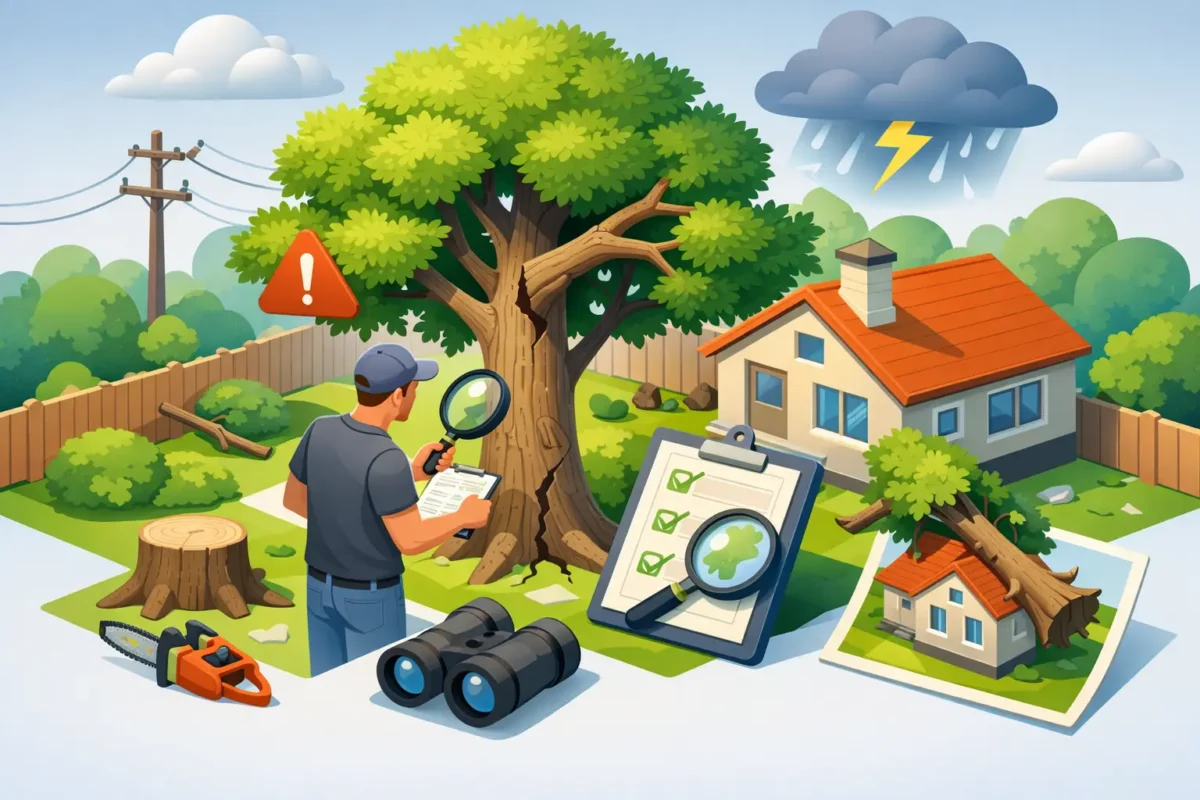
Start from a distance. Look at the whole tree shape. Does the canopy look balanced, or is one side sparse, dead, or suddenly thinning? Has the tree started leaning more than it used to? A long-standing lean is not always an emergency, but a new lean is a different story. If the ground around the base looks lifted, cracked, or disturbed, the root system may be failing.
Then move closer and inspect the trunk. Deep cracks, vertical splits, hollow sections, missing bark, or large wounds deserve attention. Fungi growing from the trunk or around the root flare can also be a sign of internal decay. Not every mushroom means the tree is failing, but decay at the base is something you should take seriously.
Next, look up into the crown. Dead limbs are one of the most common hazards on residential properties. They can drop without much warning, especially after heat, wind, or ice. Branches with weak attachment points, especially narrow V-shaped unions with included bark, are more likely to split. If you see large limbs extending over your home, parked cars, or a neighbor’s property, the stakes are higher.
The biggest warning signs to watch for
Some issues can wait for routine trimming or monitoring. Others need faster action. The difference matters.
A tree may need urgent professional attention if you notice a sudden lean, exposed or heaving roots, a major split in the trunk, hanging broken limbs, or large dead branches over a target area. Storm-damaged trees also move into the urgent category when branches are cracked but still attached. Those are especially dangerous because they can fall while you are standing underneath trying to get a better look.
Other warning signs are serious but not always immediate emergencies. These include gradual dieback, thinning leaves during the growing season, cavities, bark loss, insect damage, and fungal growth. These problems often point to decline or structural weakness, but the timing of service depends on the tree species, location, and extent of the damage.
This is where honesty matters. Not every imperfect tree needs removal. Some can be pruned, reduced, cabled, or monitored. But if a tree has severe structural defects and sits close to your house, waiting usually makes the job more dangerous and more expensive.
How to assess the area around the tree
The tree itself is only half the equation. You also need to assess what it could hit.
Ask yourself a few simple questions. If this limb fails, where does it land? If the whole tree comes down, does it reach the roof, driveway, shed, fence, sidewalk, or street? Does it threaten a play area, patio, pool, or entrance used every day?
A tree with moderate defects in an open area may be manageable. The same defects over a bedroom, garage, or neighbor’s yard create a much bigger liability issue. Small commercial property owners should think the same way. Trees near parking areas, entryways, and tenant walkways deserve closer attention because the risk includes both damage and injury claims.
What homeowners should never do themselves
A visual assessment is smart. Climbing, cutting, or trying to “test” a damaged tree is not.
Do not pull on cracked limbs. Do not climb a leaning tree. Do not get under branches that are hanging after a storm. Do not try to cut large limbs near the house with a ladder and a chainsaw. That is how people get badly hurt.
If a tree is near utility lines, treat it as a no-go zone and keep your distance. If storm damage has left part of the tree suspended or twisted, assume it is unstable. Emergency removals and hazard pruning require the right equipment, training, and insurance.
When to monitor and when to call now
There is a difference between a tree that should be watched and a tree that should be dealt with before the next storm.
Monitoring makes sense when the tree is generally stable, the defect is minor, and there is limited risk to structures or people. You may still need pruning or a professional inspection, but it is not a same-day issue.
Call now if the tree has changed suddenly, especially after weather events. New leaning, root plate movement, split trunks, broken tops, and hanging limbs should be treated as priority problems. The same goes for dead trees near homes or heavily used parts of the property. Dead wood becomes brittle, and failure can happen with very little warning.
In counties across New York where strong storms, snow, and saturated ground are common, timing matters. Waiting until the tree actually falls is the worst-case plan. A faster response can prevent roof damage, blocked driveways, crushed fences, and emergency cleanup costs.
Why professional assessment is worth it
A homeowner check is useful, but it has limits. Some decay is internal. Some root problems do not show obvious symptoms until the tree is already unstable. A licensed and insured tree professional can evaluate structure, weight distribution, deadwood, storm damage, and whether the tree can be made safer with pruning or needs removal.
Just as important, a good company should not push work you do not need. Sometimes the safest recommendation is removal. Sometimes the right answer is targeted pruning and follow-up. The value is in getting a straight answer based on actual risk, not fear.
That is especially important after storms, when homeowners are stressed and vulnerable to bad advice. A trusted local company with real emergency experience can tell the difference between a tree that needs immediate action and one that can wait.
A simple schedule that helps prevent bigger problems
Most homeowners do not inspect their trees until something breaks. That is understandable, but it is costly.
A better habit is to check your property at the start of spring, during mid-summer, and again in late fall after leaves drop. Then do an extra walk-around after major storms. Leaf-off inspections are especially helpful because you can see the branch structure more clearly. If you have mature trees near the house, routine pruning every few years can reduce weight, remove deadwood, and lower storm risk.
If you are unsure what you are seeing, get a professional opinion before the next weather event pushes a manageable problem into an emergency. Companies like AAA Tree Service NY often provide free estimates, which makes it easier to address a concern before it turns into damage.
The safest tree plan is not to remove everything that looks imperfect. It is to pay attention, act early, and treat sudden changes seriously. A few minutes spent checking your trees now can save you from a much bigger problem when the wind picks up. Contact Us