How New Technology in Tree Inspections Helps

A tree can look solid from the driveway and still have serious problems inside. That is why new technology in tree inspections matters to homeowners and property managers who want to avoid damage before the next storm, not after it. If you have a large tree near your roof, driveway, power line, or parking area, better inspection tools can lead to faster, safer decisions.
For years, tree inspections depended mostly on visual checks, experience, and a few basic tools. That still matters. A trained eye can spot deadwood, poor branch structure, root flare issues, and storm damage quickly. But some defects are easy to miss when decay is hidden inside the trunk or roots are failing below the surface. Newer inspection tools help confirm what is happening without rushing to remove a tree that may still be safe with the right care.
What new technology in tree inspections actually includes
The phrase sounds more high-tech than it needs to. In practical terms, it means using better tools to answer simple questions. Is the tree structurally sound. Is there hidden decay. Are roots failing. Does this tree need removal now, or can it be pruned and monitored?
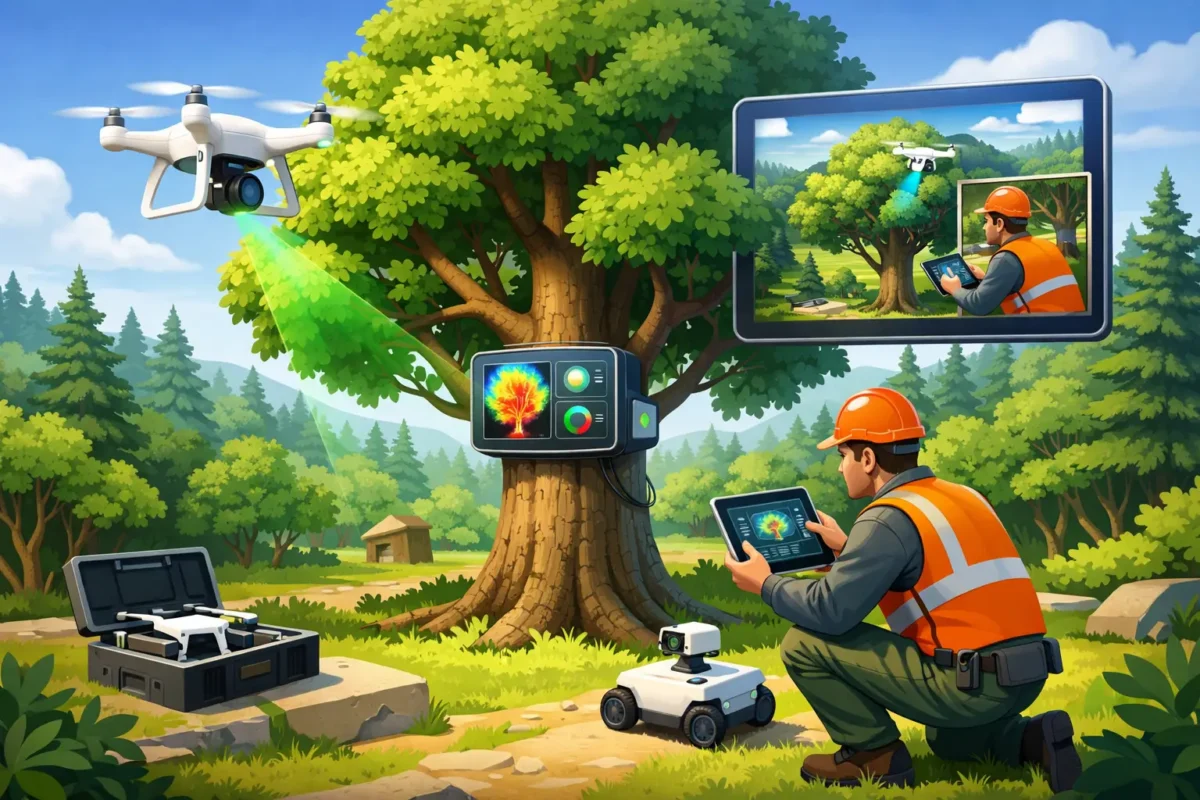
One of the most useful tools is sonic or acoustic testing. This method measures how sound waves move through the trunk. Solid wood carries the signal differently than decayed wood, so the test can help show whether there are hollow or weakened sections inside. For a homeowner, the value is straightforward. A tree that looks questionable from the outside can often be assessed with more confidence before major decisions are made.
Resistance drilling is another tool used in some inspections. It uses a very small drill bit to measure resistance as it moves into the wood. Strong wood offers more resistance. Decayed or hollow sections offer less. This is not something used on every tree, and it is not the first step for every visit. But in a high-risk situation, like a large tree leaning toward a house, it can provide useful evidence.
Ground-penetrating radar and root imaging tools are also becoming more relevant, especially around commercial sites, sidewalks, and driveways. Root problems are a major reason trees fail. The challenge is that root damage is often hidden. Construction activity, compacted soil, poor drainage, and years of stress can weaken support roots long before the canopy shows obvious decline.
Drones are another practical change. They allow crews to inspect canopies, storm damage, split leaders, and dead upper limbs without putting a climber in the tree too early. That improves safety and speeds up assessment after severe weather. If a tree has been struck by wind or ice, getting a close overhead look can help determine whether it needs emergency removal or a more controlled trimming plan.
Why better inspection tools matter for your property
The biggest benefit is not the technology itself. It is better judgment. Homeowners do not need fancy equipment for the sake of it. You need a reliable answer about risk.
A good inspection can prevent two expensive mistakes. The first is waiting too long on a tree that is clearly unsafe. The second is removing a tree that could have been preserved with pruning, cabling, or routine care. Newer tools help narrow that gap.
This matters even more in areas that see heavy wind, wet snow, and saturated ground. In parts of New York, storms can turn a manageable defect into a major emergency fast. A tree with internal decay may stand for years, then fail when the ground softens and the canopy catches wind pressure. Better inspections help identify those weak points before they become a 2 a.m. problem.
For commercial properties, there is another issue. Liability. If a large branch drops into a parking lot or a failing tree damages a neighboring property, questions come up fast about maintenance and known hazards. Documented inspections and honest recommendations give you a clearer basis for action.
What technology can find that a visual inspection may miss
Visual inspections still come first, and they should. Many risks are visible if you know what to look for – fungal growth, cavities, bark separation, trunk cracks, exposed roots, dead crown sections, and sudden lean. But technology helps when symptoms are unclear or when the tree is too important or too risky to guess about.
Internal decay is the obvious example. A trunk can have enough outer wood to look stable while the center has been compromised. Root plate weakness is another. You may notice slight soil heaving or a subtle lean after storms, but the real issue can be below grade. Canopy inspections by drone can also reveal broken or hanging limbs high above the ground that are not visible from one side of the yard.
That said, no tool gives a perfect yes-or-no answer in every case. Trees are living structures, not steel beams. A scan may suggest decay, but the actual risk depends on species, size, location, load, weather exposure, and where the weak point sits. That is why experience still matters as much as the equipment.
The trade-offs homeowners should know
More data is helpful, but it does not replace common sense. Some inspections do not need advanced testing. If a tree is dead, split, uprooting, or hanging over your house after a storm, the next step is usually clear. In emergency situations, speed and safety matter more than a detailed diagnostic process.
Cost is another factor. Advanced testing may make sense for a high-value mature tree or one near a structure where the decision is not obvious. It may not be worth it for a smaller tree in an open area with visible decline. Honest tree companies should tell you that. Not every problem needs a high-tech answer.
There is also the issue of timing. Technology can support better planning, but it does not stop a dangerous tree from failing while you wait too long to act. If there are major warning signs like fresh cracking sounds, sudden lean, split trunks, root lift, or large broken limbs, you need prompt on-site help.
How a modern tree inspection should work
A solid inspection starts with the basics. The crew looks at species, age, size, structure, prior pruning, lean, root zone condition, and targets nearby like homes, garages, sidewalks, vehicles, and utility lines. They ask about recent storms, construction, trenching, drainage problems, and changes in the canopy.
If the risk is obvious, the recommendation should be direct. If the issue is less clear, that is where newer tools can help confirm the next step. Maybe the tree needs selective pruning and monitoring. Maybe it needs support. Maybe the internal damage is too severe and removal is the safer call.
The key is that you should get a plain-English explanation. You should understand what was found, why it matters, and how urgent the work really is. Safety-first companies do not try to scare you into unnecessary removal. They also do not tell you to wait when the signs point to failure.
When you should ask about new technology in tree inspections
It makes the most sense when you have a large mature tree near a house, a tree with visible stress but no clear answer, storm damage in the upper canopy, or signs of internal decay like cavities and fungal growth. It is also worth asking about if a tree suddenly starts leaning, if roots may have been damaged by construction, or if you manage a commercial site where documented risk assessment matters.
For many homeowners, the real question is simpler. Do I need emergency removal, or can this be managed safely? That is where experience and newer tools work best together.
At AAA Tree Service NY, that balance matters. You want fast help when there is real danger, but you also want honest advice when a tree can be maintained instead of removed. The right inspection should give you both.
If you are looking at a tree and wondering whether it is a problem now or a problem waiting for the next storm, do not guess. A careful inspection using the right tools can give you a much clearer answer and help you protect your home before weather makes the decision for you.