Who Pays for Fallen Tree Damage?

A tree comes down fast, but the questions start even faster. If you are asking who pays for fallen tree damage, the answer usually depends on where the tree landed, why it fell, and whether anyone ignored a known hazard before the storm.
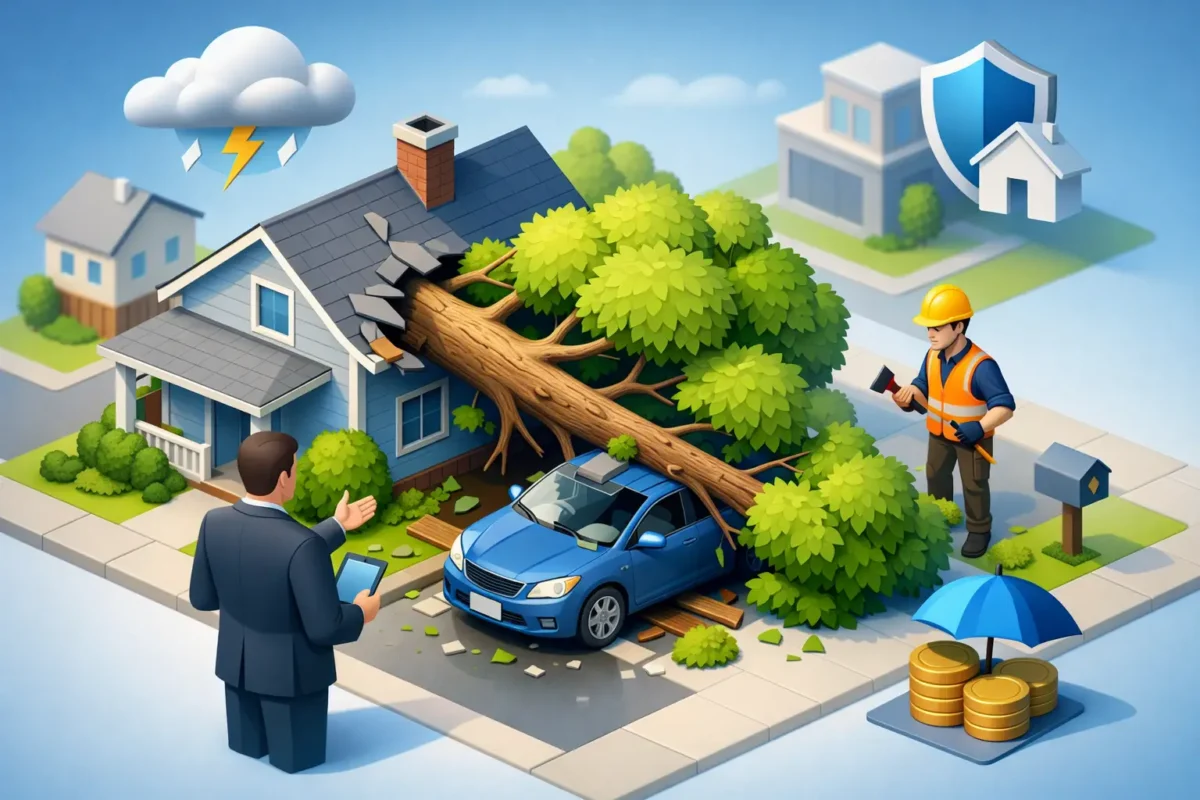
Most of the time, your own homeowners insurance pays for damage to your house, garage, fence, or other covered structure on your property – even if the tree came from your neighbor’s yard. That surprises a lot of people. They assume the tree owner automatically pays. In many cases, that is not how it works.
Who pays for fallen tree damage in most cases?
The general rule is simple. If a healthy tree falls because of high winds, heavy snow, or another sudden weather event, the property owner whose home or structure was damaged files a claim with their own insurance company.
That means if your neighbor’s tree falls onto your roof during a storm, your policy often handles the damage to your roof first. Your insurer may later look into whether another party was negligent, but that is a separate issue.
This is why the real question is not just who owned the tree. It is whether the fall was an unavoidable act of nature or the result of neglect.
When your neighbor may have to pay
There are situations where the tree owner can be responsible. The key issue is negligence. If the tree was clearly dead, badly leaning, split, hollow, or dropping large limbs for months, and the owner knew about it or should have known, they may be liable for the damage.
For example, say a large oak had visible rot at the base and several dead limbs hanging over your driveway. You warned your neighbor, or they had already been told by a tree company that it was unsafe, but nothing was done. If that tree later falls and damages your home, there is a stronger case that the tree owner should pay.
That does not mean payment happens instantly. You still may need to file through your own insurer first. Insurance companies sort out responsibility after the emergency is under control.
What insurance usually covers
Homeowners insurance often covers damage from a fallen tree if the tree hits a covered structure such as your house, detached garage, shed, or sometimes a fence, depending on the policy. It may also help pay for debris removal, but there are usually limits.
Coverage gets less generous when the tree falls without hitting anything important. If a tree lands in your yard and does not damage a covered structure, insurance may not pay for full removal. Some policies offer limited cleanup coverage, while others do not.
Cars are handled differently. If a fallen tree hits your vehicle, that is generally a claim under your auto policy if you carry comprehensive coverage.
When insurance may not pay
Insurance is not a blank check for every fallen tree problem. A few common situations can lead to denied or reduced coverage.
If the tree was dead for a long time and you did nothing, your insurer may argue that the damage was preventable. If the tree falls in the yard and misses all structures, the removal may be your out-of-pocket expense. If the damage is to something your policy does not cover, payment can also be limited.
This is one reason routine inspections matter. A tree that looks stable from the street can still have root damage, internal decay, or storm cracks that make it dangerous before the next weather event.
What if the tree falls from your yard into your neighbor’s yard?
This is where people get nervous, especially if the tree came from their property. But ownership alone does not always decide fault.
If your tree was healthy and a major storm took it down, your neighbor will usually turn to their own insurance for damage on their property. If your tree was obviously unsafe and you ignored it, you may end up responsible.
The safest approach is to deal with warning signs early. Dead limbs, hollow trunks, exposed roots, sudden leaning, and cracks after a storm should never be brushed off. Waiting can turn a manageable tree removal into a roof claim, a legal dispute, or both.
Who pays for fallen tree removal?
Removal costs depend on what the tree hit and where it landed. If the tree damaged a covered structure, insurance often pays at least part of the removal cost because clearing the tree is necessary to access and repair the damage.
If the tree simply falls across your lawn, your driveway, or an open area, coverage is less certain. Some policies pay only when the fallen tree blocks a driveway or wheelchair ramp. Others pay nothing unless a structure was hit.
If the tree came down on a public road or power lines, the utility company or municipality may handle part of the response, but that does not always include cleanup on your private property. In an emergency, the first priority is safety, not sorting out every invoice on the spot.
What to do right after a tree falls
Start with safety. Stay away from downed limbs, hanging branches, and anything touching utility lines. A tree can shift without warning, and storm-damaged wood is unpredictable.
Take photos from a safe distance. Document where the tree came from, what it hit, and any visible signs of decay or prior damage. If the tree came from a neighbor’s property and there had been obvious warning signs, that documentation matters.
Then call your insurance company. Ask what emergency work is approved, what they need for the claim, and whether temporary protection like tarping is covered. If the tree is on your house, in your driveway, or creating an immediate hazard, get a professional tree service out quickly.
A licensed and insured crew can remove the tree safely, reduce further damage, and provide the kind of documentation insurers often ask for. In storm situations across counties like Albany, Nassau, Suffolk, and Orange, quick response matters because a partially fallen tree can fail the rest of the way with the next gust.
How to prove negligence if it becomes a dispute
If the issue turns into a responsibility argument, proof matters more than opinions. Photos taken before and after the fall can help. So can written estimates, inspection reports, and any text messages or emails showing that the tree owner knew about the hazard.
A history of visible problems strengthens the case. Dead limbs, fungus at the base, trunk cavities, severe lean, and previous branch failures are all signs that a reasonable property owner should take seriously.
That said, not every bad-looking tree creates automatic liability. Some trees fail with little visible warning, especially after saturated soil, hidden root rot, or extreme wind. That is why these cases are often fact-specific.
The best way to avoid the payment fight
The cheapest claim is the one you never have to file. If you have a tree close to your home, over your driveway, or near a neighbor’s structure, get it checked before the next storm season. The same goes for commercial properties where foot traffic and parked cars increase your liability.
Honest tree care is not about cutting everything down. Many trees can be trimmed, cabled, monitored, or left alone if they are sound. But if a tree is dead, split, uprooting, or dropping heavy limbs, waiting usually makes the risk worse, not better.
If you are unsure whether a tree is an emergency or something that can wait, a safety-first inspection gives you a clearer answer. Companies like AAA Tree Service NY handle both urgent storm calls and preventive work, which matters because the right recommendation is not always full removal.
When a tree falls, the money side can get messy fast. The practical first step is to protect people, prevent more damage, and document everything. Once the immediate hazard is under control, insurance and liability questions are much easier to sort out than they are with a tree still on your roof.