DIY vs Professional Tree Removal

A chainsaw, a ladder, and a tree leaning toward your roof can make a bad situation look manageable for about five minutes. That is usually when the real question hits: DIY vs professional tree removal – what is actually safe, what saves money, and what could end up costing you far more?
If the tree is small, clear of structures, and easy to reach, some light work may be within reach for a careful property owner. But once height, power lines, storm damage, rot, heavy limbs, or a tight drop zone enter the picture, the risk changes fast. Tree removal is one of those jobs where a mistake is not just messy. It can damage your home, injure someone, or leave you dealing with insurance problems on top of repair bills.
DIY vs professional tree removal: what really changes
The biggest difference is not just who holds the saw. It is who carries the risk, who knows how the tree will react under pressure, and who has the equipment to control the job from start to finish.
With DIY tree removal, you are relying on your own judgment, tools, physical reach, and ability to predict how the tree will fall. That sounds straightforward until you are dealing with internal decay, uneven weight distribution, cracked limbs, a slope, wet ground, or wind. Trees rarely fail in neat, predictable ways.
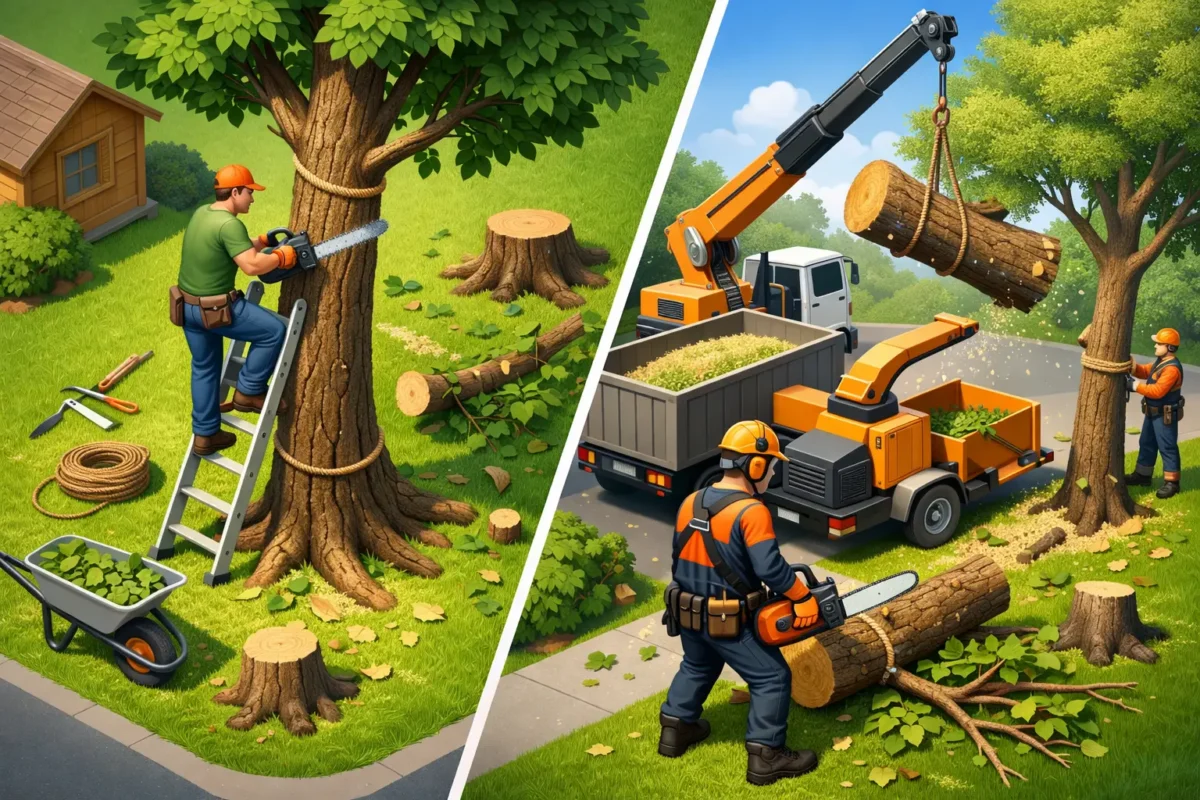
With professional tree removal, the work starts before the first cut. A trained crew looks at lean, canopy weight, trunk condition, nearby structures, access points, and how to lower sections safely. Licensed and insured professionals also bring the gear most property owners do not have on hand, such as rigging systems, climbing equipment, bucket trucks, cranes when needed, and heavy cleanup equipment.
That is why the same tree that looks like a weekend project from the driveway may be a serious hazard up close.
When DIY tree removal may be reasonable
There are a few situations where doing it yourself can make sense. Usually, that means the tree is very small, already down, or more like large brush than a mature tree.
If you are removing a young tree with a thin trunk in an open area, far from your house, fence, shed, driveway, vehicles, and utility lines, the risk is lower. The same can be true for cutting up small limbs that have already fallen after a storm, as long as they are not tangled, suspended, or under tension.
Even then, lower risk does not mean no risk. Homeowners still get hurt by kickback, falling branches, unstable ladders, and limbs that spring when cut. Protective gear matters. So does knowing when to stop.
A good rule is simple: if you need to ask whether it is too big, too close, too damaged, or too unstable, it probably is.
The hidden limits of homeowner equipment
Most DIY tools are made for light cutting, not controlled tree removal. A basic chainsaw may be fine for firewood or storm debris on the ground. It is not the same thing as safely taking down a tree in sections over a roofline.
Ladders are another common problem. People use them to reach limbs that should never be cut from an unstable position. Once the branch shifts, the ladder can move with it. That is how routine yard work turns into an emergency call.
There is also cleanup. Even if you manage the cutting, you still have brush, trunk sections, and possibly a stump to deal with. What starts as a money-saving plan can turn into a full weekend, rented equipment, dump fees, and a yard that still is not fully safe.
When professional tree removal is the smarter call
If the tree is dead, leaning, storm-damaged, hollow, split, large, or near anything valuable, this is where professional removal becomes less of a luxury and more of a practical decision.
A tree near your home, garage, business, fence, sidewalk, parked cars, or utility lines should be treated carefully. The same goes for a tree that has dropped major limbs, has exposed roots after a storm, or suddenly started leaning. These are not cosmetic issues. They are warning signs.
Professional crews are also the right call when access is tight. In many residential areas, there is not enough room to just drop a tree in one piece. It has to be dismantled section by section and lowered in a controlled way. That is skilled work.
In storm-prone parts of New York, this matters even more. Wind, saturated soil, snow load, and ice can weaken a tree in ways that are not obvious from the ground. A tree may still be standing, but no longer stable.
Professional removal can protect more than the tree area
The real value of hiring a pro is often what does not happen. Your roof stays intact. Your fence does not get crushed. Your neighbor’s property is not involved. No one gets hurt trying to improvise a dangerous cut.
There is also the insurance side. If a tree causes damage during a DIY removal attempt, your claim may become more complicated. Licensed and insured contractors are hired for exactly this reason. They reduce your exposure when the stakes are high.
Cost: cheaper upfront is not always cheaper overall
DIY usually looks less expensive at first. You may already own a saw, or think you can rent what you need. If all goes well, that can be true for very small jobs.
But tree removal costs are not just about labor. They include safety planning, specialized equipment, hauling, debris disposal, and handling the unexpected. If your DIY attempt goes wrong, the price jumps quickly. One broken gutter, damaged fence panel, smashed windshield, or emergency room visit wipes out the savings.
Professional tree removal costs more upfront because you are paying for experience and risk control. You are also paying for speed. A trained crew can often do in hours what takes a homeowner an entire weekend, with far less danger and a cleaner result.
That does not mean every tree needs full removal by a crew. Sometimes pruning, deadwood removal, or selective cutting is enough. Honest companies will tell you that. If a tree can be made safe without taking it down, that should be part of the conversation.
Questions to ask before you decide
Before you choose DIY or hire a crew, look at the tree and your property honestly.
How tall is it, and where would it fall if something goes wrong? Is it close to your house, driveway, sidewalk, or a neighboring property? Are there overhead wires? Does the trunk show cracks, rot, hollow spots, or fungal growth? Has it shifted after a storm? Can you work from the ground, or would you need a ladder or climbing gear?
Then ask a harder question: if the cut does not go the way you expect, do you have any real way to control what happens next?
That is usually where the decision becomes clear.
DIY vs professional tree removal after a storm
Storm damage deserves its own category because it creates some of the worst DIY mistakes. A branch that looks down may still be hung up overhead. A partially uprooted tree may be resting on other limbs and ready to shift without warning. Split trunks can hold tension until the moment they are cut.
This is where homeowners get into trouble trying to clear the yard quickly. Fast action matters, but so does safe action. If a tree is on a structure, near live wires, blocking access, or hanging dangerously, professional emergency service is the right move.
Companies like AAA Tree Service NY handle these calls because the conditions are unpredictable and time-sensitive. The goal is not just removal. It is making the property safe again without adding more damage.
The best choice is the one that protects your property
There is nothing wrong with handling small yard tasks yourself when the work is truly low risk. But large tree removal is not a basic cleanup job. It is controlled hazard work.
If you are looking at a tree and feeling unsure, trust that instinct. Getting a free estimate from a licensed, insured crew can give you a clear answer without committing you to unnecessary work. Sometimes you will hear that the tree can wait. Sometimes you will hear that it should come down before the next storm. Either way, you are making the decision with real information.
Your home, your family, and the people who use your property count on you to make the safe call. When a tree has become a risk, the smartest move is usually the one that keeps you out from under it.