How to Spot Hazardous Branches Early

A branch usually does not fail out of nowhere. Most of the time, your tree gives you warning signs first – the kind you notice after a windy night, while mowing the lawn, or when you look up and realize one limb does not look like the rest. If you are wondering how to spot hazardous branches, the goal is simple: catch the problem before it hits your roof, car, fence, or someone standing below.
For homeowners and small property owners, this is not just about tree appearance. It is about safety, liability, and avoiding emergency damage after the next storm. Some branches need quick removal. Others can wait for routine pruning. Knowing the difference helps you act early without paying for work you do not need.
How to spot hazardous branches from the ground
You do not need to climb a ladder or know arborist terms to catch common danger signs. In fact, you should stay on the ground. A visual check from a safe distance is enough to tell you when it is time to call for a professional opinion.
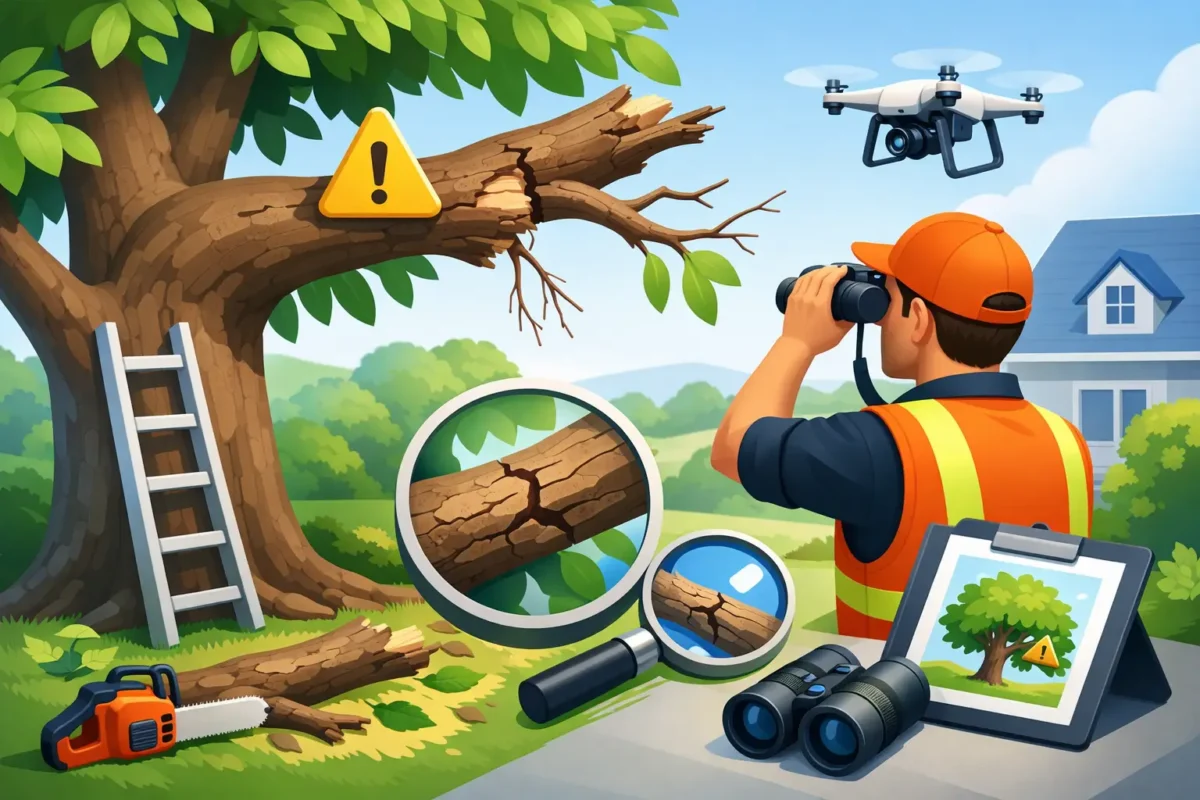
Start with the obvious. A dead branch is one of the biggest risks in any tree. If a limb has no leaves during the growing season while the rest of the tree looks healthy, that is a red flag. The same goes for bark falling off in large sections, brittle wood, or smaller twigs snapping off easily and collecting under the canopy.
Look closely at the branch connection point, where the limb joins the trunk. If you see splitting, cracking, or a deep seam forming there, that branch may already be failing. This matters even more with large limbs hanging over your house, driveway, sidewalk, or parked vehicles.
Also pay attention to branches that suddenly sag lower than before. A limb that dips after heavy rain, snow, or wind may be overloaded, internally cracked, or weak from decay. It might still be attached, but that does not mean it is sound.
The warning signs that matter most
Some defects are more urgent than others. A few scattered dead twigs are common in mature trees and do not always mean danger. A large dead limb over a target area is different.
The signs below deserve prompt attention, especially if the branch is big enough to cause damage:
- Dead wood with no leaves, peeling bark, or brittle texture
- Visible cracks, splits, or hanging wood fibers
- A branch that is partially broken but still caught in the canopy
- Mushrooms or fungal growth near the branch union or trunk
- Hollow spots, cavities, or soft, crumbly wood
- Branches rubbing against each other and wearing through bark
- Heavy limbs extending too far with poor support
- Sudden leaning or twisting after a storm
A hanging branch is an immediate hazard. Even if it looks stable, it can drop without warning. Keep people away from the area and get it handled fast.
Dead, damaged, or diseased – what is the difference?
These problems often overlap, but they are not exactly the same.
A dead branch has stopped living. It will not recover, and over time it gets drier, weaker, and more likely to fall. Deadwood is common after drought, root stress, insect activity, or simple age.
A damaged branch has been physically harmed. Storms, snow load, vehicles, bad pruning cuts, or limbs rubbing together can all cause damage. Sometimes the outside looks minor, but the wood inside is split.
A diseased branch may show wilting leaves, dark staining, cankers, odd swelling, or fungal growth. Disease does not always mean the branch will fail today, but it can weaken the wood and spread if ignored. The right response depends on the tree species, the extent of the problem, and where that branch sits over your property.
That is why honest assessment matters. Not every bad-looking limb calls for emergency work, but some absolutely do.
How to spot hazardous branches after a storm
After wind, ice, or heavy wet snow, trees in New York can change fast. A branch that survived last season may not survive the next weather event. Walk your property once conditions are safe and look up before you look down.
Fresh cracks are often easier to spot after storms because the exposed wood is lighter in color. You may also notice one side of the canopy thinning out, leaves or needles suddenly browning, or a branch hanging lower than it did before. If you hear creaking in the wind or see movement at a branch union, take that seriously.
Be extra careful around trees near power lines. If any branch is touching a line or has fallen into one, stay back and treat it as an emergency. That is not a DIY situation.
In counties that get strong wind, ice, and snow loads, storm damage is not always dramatic. Sometimes the branch does not fall right away. It weakens first, then lets go days later when the weather shifts again.
When a branch is more dangerous because of where it is
A branch over open lawn is not the same as a branch over a bedroom, entrance, play area, or parking lot. Location matters just as much as condition.
Even a moderately weak limb becomes a serious concern when it hangs over your roof, deck, driveway, or neighbor’s property. Commercial properties have another layer of risk because of customer access, tenant safety, and liability exposure. If people walk or park beneath that branch, waiting too long can get expensive fast.
Size matters too. A small dead limb high in the canopy may not need same-day service. A large cracked branch over a structure often does.
What homeowners often miss
The biggest mistake is focusing only on leaves. A branch can leaf out and still be structurally weak. Summer growth does not always mean the wood is sound.
Another missed sign is included bark. This happens when two stems or tight branch unions grow pressed together instead of forming a strong attachment. From the ground, it can look like a narrow V-shape where the bark is pinched inward. Those unions are more likely to split under wind or snow load.
People also underestimate old pruning wounds. If a tree was topped years ago or large limbs were cut poorly, the regrowth can become long, heavy, and weakly attached. It may look full and green, but that does not make it safe.
What you should not do
If you suspect a hazardous branch, do not stand underneath it to get a better look. Do not climb the tree. Do not pull on a hanging limb with a rope. And do not start cutting if the branch is large, cracked, or near a structure or utility line.
This is where injuries happen. Tree work looks simple from the ground, but unstable limbs can shift fast and fall in the wrong direction. The risk goes up with chainsaws, ladders, and storm-damaged wood.
A safer move is to mark off the area, keep kids and pets away, and get a professional evaluation. If the branch threatens immediate damage, treat it like an urgent service call.
When to call for help right away
You should call quickly if a branch is hanging, split, touching a structure, blocking access, or threatening a high-use area. The same goes for limbs close to power lines or trees that changed shape after a storm.
If you are unsure, that is enough reason to ask. A good tree service will tell you whether the branch needs emergency removal, routine pruning, or simple monitoring. You want a company that is licensed, insured, and used to working in real storm conditions – not one that pushes removal when pruning will solve the problem.
For property owners in places like Albany County, Nassau County, Suffolk County, and other parts of New York where storms can turn a weak limb into a fallen limb overnight, fast response matters. AAA Tree Service NY handles this kind of risk with a safety-first approach and honest recommendations, whether the job is urgent or preventive.
A simple habit that prevents bigger problems
You do not need to inspect your trees every week. But you should look at them a few times a year, especially after storms and before hurricane season, winter snow, or heavy spring growth. Stand back, look at the canopy shape, and notice what changed.
That one habit catches a lot. You will spot deadwood sooner, see storm damage before it gets worse, and make better decisions about pruning before a limb comes down on its own.
If something looks off, trust that instinct and get it checked. The best time to deal with a hazardous branch is before the weather does it for you.