Tree Cabling vs Bracing: Which Does Yours Need?

A tree with a split trunk or a heavy limb hanging over your roof may not need to come down. In some cases, tree cabling vs bracing comes down to the type of weakness in the tree and whether the structure can be safely supported. The right system can reduce the chance of failure. The wrong one, or a delayed decision, can leave your home, vehicles, and family exposed when the next storm arrives.
Cables and braces are not cosmetic fixes. They are professional support systems used to reduce movement and relieve stress on vulnerable sections of a tree. They do not make a hazardous tree safe in every situation, and they cannot reverse decay, root damage, or severe structural failure. A qualified tree professional should inspect the whole tree before recommending either option.
Tree Cabling vs Bracing: The Main Difference
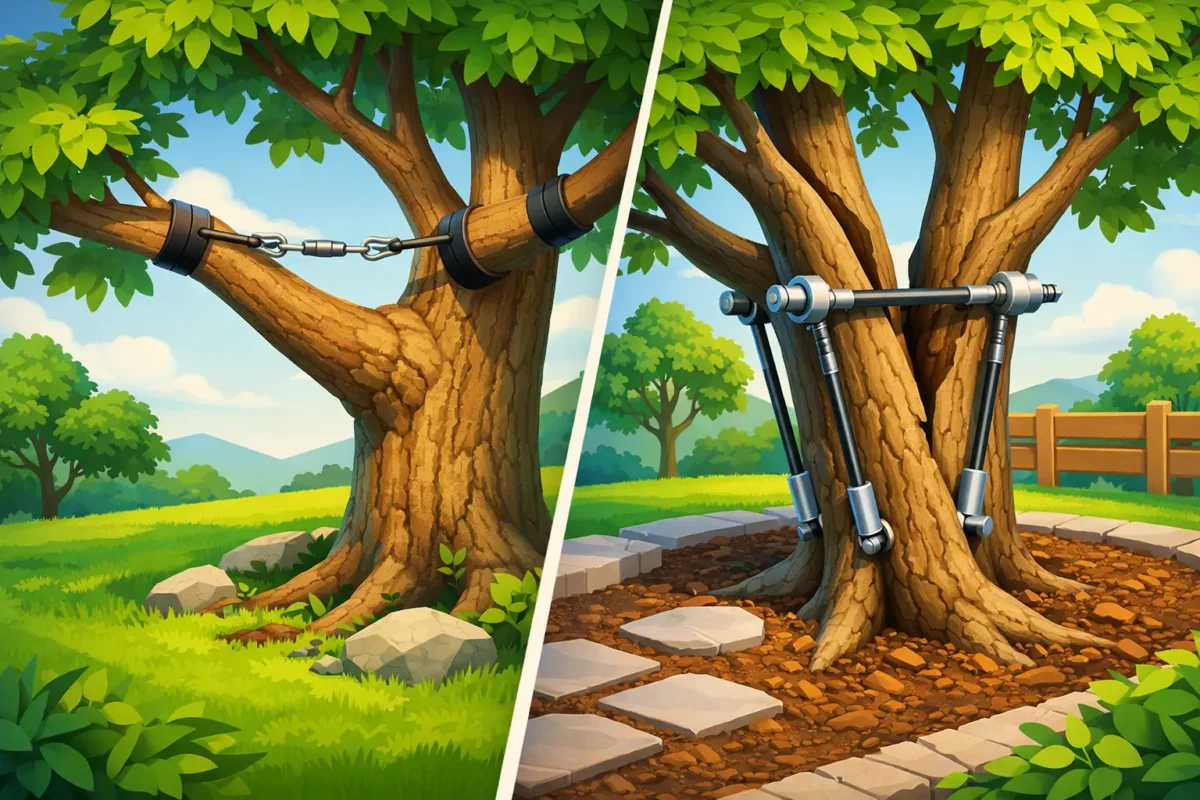
Tree cabling supports a weak limb or trunk from above. A professional installs a high-strength cable between major limbs or stems to limit how far they move apart in heavy wind, snow, or ice. The cable shares the load and reduces strain at a weak connection point.
Tree bracing provides support from within the weak area. It usually involves installing threaded steel rods through a split, crack, or weak union where two trunks meet. The rods help hold the structure together and resist further separation.
Put simply, cabling controls movement from above. Bracing reinforces a weak point directly. Many trees with significant structural weaknesses need both. For example, a tree with a narrow V-shaped union and an existing crack may need bracing rods at the split and a cable higher in the canopy to reduce the force pulling the stems apart.
When Tree Cabling May Be the Better Option
Cabling is often considered when a healthy, mature tree has one or more heavy limbs that could overextend during storms. It can be especially useful for trees with multiple trunks, broad canopies, or limbs growing over a driveway, sidewalk, roof, patio, or parking area.
A cable may be recommended when the tree has a weak branch union but no visible split. It may also help preserve a valued shade tree that is otherwise healthy and worth retaining. In many cases, selective pruning is performed at the same time. Removing excess weight from the end of a long limb reduces leverage, while the cable provides added support during high winds.
There are different cabling approaches. Static cabling uses fixed steel cable and is generally used where a more rigid level of support is needed. Dynamic systems allow limited natural movement while still reducing sudden shock loads. The right choice depends on the tree species, limb structure, location, and condition.
Cabling is not a substitute for pruning or routine inspection. A cable can reduce risk, but it does not stop a limb from growing heavier over time. It also needs periodic inspection to make sure it remains properly installed and does not become too tight as the tree grows.
When Bracing Is Necessary
Bracing is generally used when there is already a crack, split, or clear separation in the trunk or main union. These are serious warning signs, particularly when the affected area is above a structure or place where people walk, park, or gather.
A professional may recommend bracing when two leaders are beginning to pull apart, when a narrow union shows included bark, or when a storm has opened a seam in the trunk. Included bark is bark trapped between two stems. It prevents the trunks from forming a strong connection and increases the chance that they will split under load.
Bracing can slow or prevent further separation, but the tree must still be evaluated honestly. If the crack is extensive, the wood is decayed, or the trunk is badly compromised, removal may be the safer recommendation. A brace rod cannot turn a failing tree into a low-risk tree.
That is why you should be cautious of anyone who promises to save every damaged tree. Keeping a tree is worthwhile only when the remaining risk is reasonable for its location. A tree in an open yard has a different risk level than the same tree leaning over a child’s bedroom or a busy commercial entrance.
Signs Your Tree Needs a Professional Inspection
You do not need to diagnose cabling or bracing yourself. You do need to know when to call for an assessment. Pay attention to a new crack where major limbs join, a visible gap between trunks, peeling bark around a union, or a limb that suddenly hangs lower than it used to.
Other concerns include a tree that leans more after a storm, fresh wood exposed in the canopy, mushrooms or soft areas near the base, and large dead branches over targets. If you hear cracking during wind or see a split that was not there before, keep people away from the area.
Do not stand beneath the limb to inspect it closely. Do not try to pull the trunks together with rope, ratchet straps, chain, or hardware-store cable. Improper tension can worsen the split, and working around an unstable tree creates a serious injury risk.
For homes and commercial properties in New York, ice, wet snow, high winds, and saturated soil can turn a manageable defect into an emergency quickly. Getting an evaluation before storm season gives you more options than waiting until a limb has already failed.
What Cabling and Bracing Cannot Fix
Support systems are useful only when the tree has enough sound wood and a stable enough root system to justify retention. They cannot correct every hazard.
A cable will not fix advanced trunk decay. Brace rods will not stabilize roots that are lifting from the ground. Neither option can reliably solve a tree with major deadwood, extensive insect damage, a hollow trunk, or a severe lean toward your home.
They also do not eliminate maintenance. Trees grow, hardware ages, and storms change conditions. A supported tree should be inspected on a regular schedule, especially after a major wind, ice, or snow event. If the tree changes, the support plan may need to change too.
This is where an honest recommendation matters. Sometimes pruning and support can extend the life of a good tree for years. Sometimes removal is the responsible choice because the potential damage is too great. The goal is not to sell a cable or brace system. The goal is to reduce the risk to your property.
Why Installation Quality Matters
Cabling and bracing should never be treated as a quick handyman job. Proper placement requires an understanding of load, tree structure, decay, growth patterns, and the direction of likely failure. Hardware installed too low, too tight, or in the wrong location can create additional stress instead of reducing it.
The work also requires safe access to the canopy. Trees near utility lines, roofs, fences, or neighboring properties need extra planning. A licensed and insured tree service can assess whether support is appropriate, prune to reduce weight where needed, and install the system without creating unnecessary damage.
AAA Tree Service NY has more than 26 years of experience helping property owners make practical decisions about weak, storm-damaged, and overextended trees. If a tree can be safely supported, that option should be on the table. If it cannot, you deserve a clear explanation of why.
Act Before a Weak Tree Becomes an Emergency
If you can see a split, hear creaking in the wind, or notice a major limb over your home beginning to sag, do not wait for a storm to make the decision for you. A professional inspection can tell you whether selective pruning, cabling, bracing, removal, or immediate emergency work is the safest path. Protecting your property starts with addressing the weakness while there is still time to do the work safely.